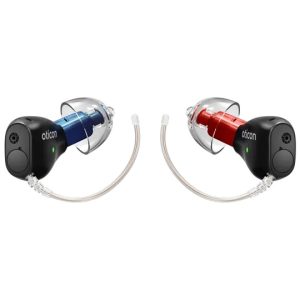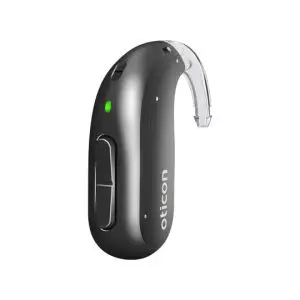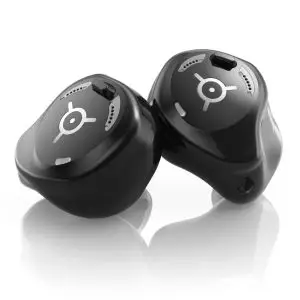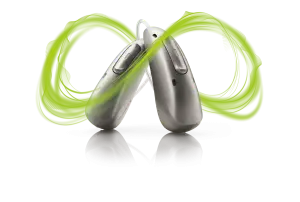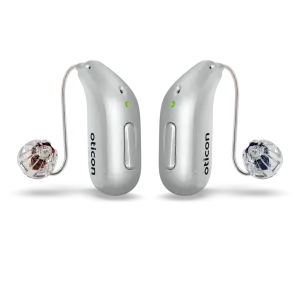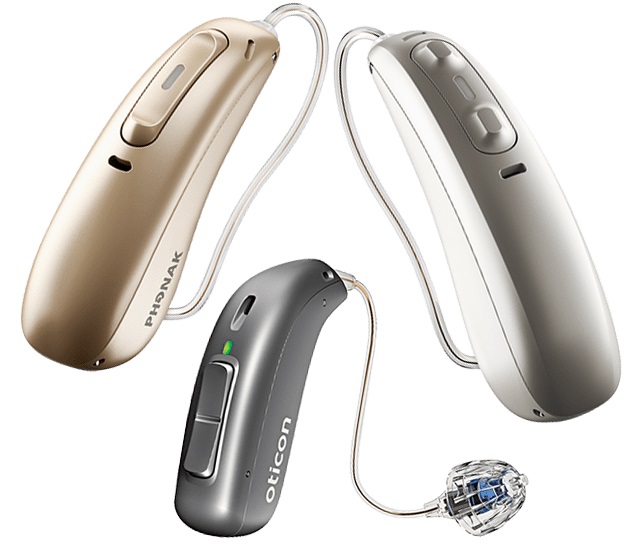
If you have been researching premium prescription hearing aids, you have almost certainly landed on both of these. The Oticon Intent sits at number one in HearAdvisor’s independent rankings of prescription hearing aids. The Phonak Audeo Ultra Sphere Infinio is in the top tier of the same testing with a dedicated AI chip for noise processing that is genuinely architecturally different from anything else in the category. Both are strong devices. Both have real limitations. Both are carried at Hears Hearing & Hearables, and we have fitted patients with each.
Since this comparison was written, Oticon has released the reveal platform built around what Oticon calls a Dual AI system, pairing independent Speech AI and Context AI processors. The Intent comparison below still holds for the Intent platform itself; contact us if you’d like to know how Reveal stacks up against the Sphere Infinio.
This is what we have actually observed in practice, which is different from what the spec sheets say.
What the Numbers Show
HearAdvisor’s independent testing, which uses standardized conditions across multiple acoustic environments, consistently places the Oticon Intent at the top of prescription hearing aid rankings for speech understanding in noise. Phonak’s Sphere Infinio performs strongly in the same testing, particularly in its most challenging noise conditions, where the dedicated AI chip shows its largest advantage over traditional processing architectures.
Both companies restrict online price display, Oticon and Phonak both operate under MAP policies that prohibit authorized retailers from posting prices publicly. We cannot display prices for either device here. Contact us for current pricing on both. What we can say is that Oticon typically runs slightly higher in price, though not always, and the gap varies by technology level and whether accessories are included.
The Core Technical Difference
Oticon Intent: BrainHearing and 4D Sensors
Oticon’s philosophy is that the brain, not the hearing aid, should do the work of deciding what to focus on. Their approach gives the brain access to a full, balanced sound scene rather than aggressively directing the listener’s attention. The Intent adds 4D Sensor technology that detects head movement, body movement, conversation activity, and acoustic environment simultaneously, adapting in real time based on what the wearer is actually doing. The result is a hearing aid that feels more passive and natural in its adaptation, working with the brain’s own processing rather than making decisions for it.
Phonak Audeo Sphere Infinio: The Dedicated AI Chip
Phonak’s Ultra Sphere Infinio uses a separate, dedicated AI chip specifically for noise suppression and speech clarity, running alongside the main processing chip rather than competing with it for resources. This architectural approach means the AI can work harder on noise without compromising the primary sound processing pipeline. AutoSense OS 7.0 classifies listening environments automatically, and the Sphere’s universal Bluetooth connectivity to both iOS and Android without compatibility restrictions is one of its most practical differentiators.
What We Actually See in Our Demo Sessions
When patients demo both devices at Hears Hearing & Hearables, the pattern is consistent enough to be worth saying plainly: most of our patients prefer Oticon’s sound.
This does not mean Phonak performs worse on noise. In controlled conditions and independent testing, Phonak’s noise processing is excellent and the dedicated AI chip delivers on its architectural promise. But hearing aid preference in the real world is not only about noise performance. It is about what sounds natural, what sounds like the world you remember, what you can wear all day without fatigue or the sense that you are listening through a machine.
Oticon’s BrainHearing approach produces a sound that many patients describe as more open, more spatial, more like how they remember hearing before loss set in. Phonak’s processing is precise and highly effective, but some patients find it sounds slightly more processed, more deliberate in its manipulation of the sound scene. The word we hear most often is that Phonak feels engineered and Oticon feels natural. Both are valid descriptions. One is not objectively better. It depends entirely on what the patient values.
The Fitting Realities We Do Not See on Spec Sheets
Phonak Fitting Challenges
We want to be honest about this because it matters for patients making a decision. Phonak’s receiver and dome fitting is not always straightforward. We have patients where we cannot achieve a tight enough fit, where feedback management is working hard in the background to compensate for an imperfect seal, and where the feedback manager is effectively rolling back gain to control the whistle rather than delivering the full prescription. Phonak’s feedback management is sophisticated, but it has limits, and those limits show up most in ear canals that do not suit standard dome sizes well.
Custom molds solve most of these problems, and for patients with challenging ear anatomy we recommend going straight to custom molds rather than starting with domes and hoping for the best. Battery life on Phonak devices has also been a consistent patient comment relative to some competitors.
Oticon Fitting Observations
Oticon’s fitting process is generally more straightforward from a feedback and fit perspective than Phonak’s. Dome fits tend to be more predictable across a wider range of ear anatomies, and feedback management is less frequently a limiting factor in achieving full prescription targets. The hardware feel is consistently positive in patient perception, our patients describe Oticon hearing aids as feeling more premium in construction compared to Phonak, with a build quality that matches the price point. Battery life on Oticon Intent is worth noting as slightly behind some competitors, less so than older Oticon platforms, but it is a real observation from our patients.
Phonak’s universal Bluetooth is a genuine, practical advantage over competitors including Oticon, which uses Bluetooth LE Audio with slightly more limited device compatibility. For patients whose primary daily use involves streaming from both iPhone and Android devices, or who use Windows computers, Phonak’s connectivity story is stronger.
A Word on Market Share and Online Reviews
Phonak has more market share than any other hearing aid manufacturer globally, and significantly more consumer-generated reviews online than Oticon. When you search for hearing aid comparisons, Phonak appears prominently, not primarily because it outperforms competitors but because more people are talking about it. Volume of discussion is not the same as the quality of the outcome.
This creates a specific bias worth knowing: when you read online that Phonak wins among consumers, part of what you are reading is that more people own Phonak, and more people talking about anything makes it appear to dominate the conversation. Many of the people recommending Phonak have never worn Oticon, and vice versa. Most hearing aid wearers have not compared the two in a controlled demo. Their preference is for what they own, not necessarily what they would choose if they had worn both.
Feature Comparison: What Actually Differs
- Bluetooth connectivity: Phonak uses Bluetooth Classic (SWORD chip) for universal connectivity to iPhone, Android, Windows, and most Bluetooth devices without compatibility restrictions. Oticon uses Bluetooth LE Audio, which offers excellent connectivity to current iPhone, iPad, Mac, and select Android devices, and is Auracast-ready, but has slightly narrower device compatibility overall. For most patients this difference is irrelevant. For patients with Android phones or Windows computers as primary devices, Phonak’s connectivity is more reliable.
- Noise processing architecture: Phonak Sphere uses a dedicated AI chip separate from the main processor. Oticon Intent uses DNN 2.0 integrated into the Sirius chip platform. Both produce excellent noise performance; the architectural difference matters most in the most demanding conditions.
- 4D Sensor technology: Oticon Intent only. Phonak has no equivalent. For patients who want hearing aids that adapt based on physical movement and conversation activity, this is Oticon-exclusive.
- Sound processing philosophy: Oticon delivers a full, open sound scene and lets the brain process it. Phonak actively directs attention and suppresses competing signals. Neither is universally superior; the preference depends on the patient’s auditory processing style.
- Tinnitus support: both offer integrated tinnitus sound therapy programs. Oticon’s Tinnitus SoundSupport is available at all four technology levels. Phonak’s Tinnitus Balance is available through the myPhonak app on compatible platforms.
- Remote care: Phonak supports more comprehensive remote fitting workflows including initial fittings under certain circumstances. Oticon requires an in-person first fitting and does not currently support remote tinnitus adjustments. For patients who need fully remote care, Phonak has the stronger telehealth story. [LINK to Oticon telehealth post]
- Roger system: Phonak’s proprietary Roger wireless microphone system for classrooms, meetings, and group settings has no direct Oticon equivalent. For patients in educational settings or who need multi-listener wireless microphone capability, this is a meaningful Phonak advantage.
- Form factor and build quality: Oticon Intent is a smaller, more premium-feeling device in patient perception. Phonak Sphere is slightly larger and perceived as less premium in build by some patients. A smaller Phonak model is forthcoming that may change this comparison.
- Battery life: Phonak generally performs well on battery life. Oticon Intent improved substantially over previous Oticon generations but still draws some patient comments relative to competitors. Both offer rechargeable and portable charging options.
Who Should Choose Oticon Intent
- Patients who prioritize natural sound quality above all else: the open, spatial, brain-centered sound processing consistently wins our demo sessions for patients who describe wanting to hear the world, not just speech in noise.
- Patients with active, varied listening lives: the 4D Sensor’s adaptive behavior based on movement and conversation activity provides a noticeably more seamless automatic experience throughout a full day.
- Patients who are comfortable with in-person first fittings: the telehealth limitation is not an issue for patients who have clinic access.
- Patients who want a more predictable fitting experience: Oticon’s dome and receiver fitting is generally more straightforward across a wider range of ear anatomies than Phonak’s.
Who Should Choose Phonak Audeo Sphere Infinio
- Patients whose primary priority is speech in noise in demanding environments: the dedicated AI chip’s advantage shows most clearly in the most difficult acoustic conditions, multi-talker restaurants, large group settings, lecture halls.
- Patients who use Android phones or Windows computers as primary devices: Phonak’s universal Bluetooth is more reliable across a wider device range.
- Patients who need or want the Roger system: no Oticon equivalent exists for multi-listener wireless microphone integration.
- Patients who need fully remote care: Phonak’s telehealth support is more comprehensive than Oticon’s current offering.
- Patients whose ear anatomy works well with Phonak domes: for patients for whom the fit clicks, Phonak performs excellently. Those with challenging anatomy should plan for custom molds from the start.
There is no definitive published research comparing the Oticon Intent and the Phonak Sphere Infinio head-to-head in the same study population under the same conditions. The comparisons that exist are from independent testing organizations like HearAdvisor using standardized conditions, not from clinical trials on real patients in real environments. This matters: standardized testing captures certain dimensions of hearing aid performance and misses others. Patient preference in real-world use, which is what we observe in our clinic, is a different and equally valid data point.
The Bottom Line
Both are excellent hearing aids. The decision comes down to three things: preference, priority, and cost.
Preference is best determined by a demo. Spec sheets and reviews, including this one, cannot tell you what sounds right to your ears. If you are considering either or both devices, a demonstration in realistic listening conditions is the most useful step you can take. We offer demos at Hears Hearing & Hearables at our Hopkins, Minnesota clinic and via telehealth for patients who need remote consultation before purchase.
Priority means knowing what matters most to you: sound naturalness, noise performance in demanding environments, Bluetooth connectivity, remote care capability, Roger system access, or some combination. We have tried to be honest above about which device is stronger on each dimension.
Cost: both companies restrict online price display. Contact us for current pricing on each. Oticon generally runs slightly higher but the gap varies, and at the technology level where most patients end up, the difference may be less significant than the spec comparison suggests.
Want to hear both devices and make the decision with your own ears rather than someone else’s review? Contact Hears Hearing & Hearables to arrange a demo. We carry and fit both Oticon and Phonak and will tell you honestly what we observe in your specific situation.
Frequently Asked Questions: Oticon Intent vs Phonak Audeo Sphere Infinio
Which is better for hearing in noise, Oticon Intent or Phonak Sphere?
Both perform well in noise but through different approaches. Phonak’s dedicated AI chip shows its largest advantage in the most demanding noise conditions, multi-talker environments, crowded rooms, and complex acoustic situations. Oticon’s DNN 2.0 and 4D Sensor technology also produce strong noise performance with a more open, less aggressive processing approach. In our clinical demo experience, patients who prioritize natural sound quality in noise tend to prefer Oticon; patients who want maximum noise suppression in the hardest listening situations tend to prefer Phonak. HearAdvisor’s standardized testing places Oticon at number one overall, but both are top-tier performers.
Why does Oticon seem more popular in your clinic if Phonak has more market share?
Market share and patient preference are not the same thing. Phonak has the largest global market share of any hearing aid manufacturer, which means more people own Phonak devices and more people are talking about them online. Many of those people have never worn Oticon. In our demo sessions, where patients try both before deciding, Oticon’s sound wins more often. That is a different data set from global sales numbers, and both are real and valid observations.
Is Phonak’s Bluetooth better than Oticon’s?
Phonak uses Bluetooth Classic technology that connects universally to iPhone, Android, Windows, and most Bluetooth devices without compatibility restrictions. Oticon uses Bluetooth LE Audio, which offers excellent performance with current iPhone, iPad, Mac, and select Android devices, and supports Auracast. For most patients the difference is not meaningful in daily use. For patients with Android phones, Windows computers, or a wide range of Bluetooth devices, Phonak’s connectivity is more reliable across the board.
Do both Oticon and Phonak hide their prices?
Yes. Both operate under minimum advertised price (MAP) policies that prohibit authorized retailers from publicly displaying prices. This applies to every authorized provider equally. Contact Hears Hearing & Hearables for current pricing on both devices, along with an honest comparison of what each costs at the technology level that suits your listening needs.
How do I decide between Oticon and Phonak without trying both?
Honestly, you should try both if at all possible. No comparison article, including this one, can tell you what sounds right to your ears. The most useful thing you can do is arrange a demonstration that lets you hear both devices in realistic listening conditions before committing to either. We offer hearing aid demonstrations at Hears Hearing & Hearables specifically for this purpose. If a demo is not possible, the clearest deciding factors are: connectivity needs (Android/Windows users lean Phonak), remote care needs (fully remote patients lean Phonak), Roger system needs (Phonak only), and natural sound preference (our demo patients lean Oticon).