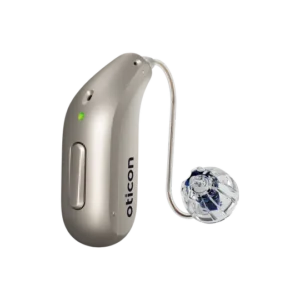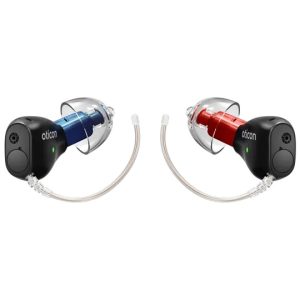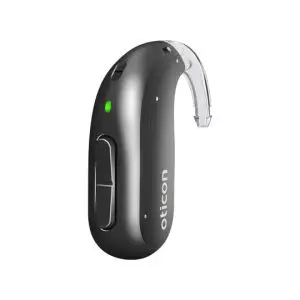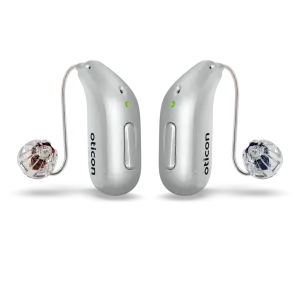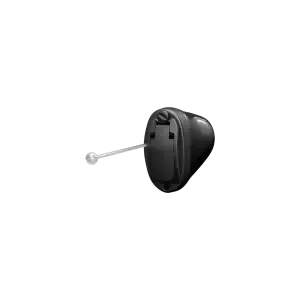
The standard approach to hearing aid noise management is intuitive: identify speech, amplify it; identify noise, suppress it. The hearing aid does the work of sorting, and the listener receives a cleaner, pre-processed version of the acoustic scene. This approach helps, and for many patients it helps substantially.
Oticon’s BrainHearing philosophy begins with a different premise. Hearing does not happen in the ears. It happens in the brain. The auditory cortex receives the acoustic signal and performs the extraordinary work of source separation, attention allocation, and meaning extraction. When a hearing aid pre-processes and edits the acoustic scene before it reaches the brain, it reduces the information the brain has to work with. Then the brain has to work harder, not less, to make sense of what it is receiving.
The Neuroscience Behind BrainHearing
The auditory brain is not a passive receiver. It actively predicts incoming sounds based on context, allocates selective attention to relevant sources, suppresses irrelevant sources internally, and integrates what it hears with visual cues, linguistic expectation, and memory. This active processing requires a complete acoustic signal, not a curated one.
Research on listening effort and cognitive load in hearing aid users shows that more aggressive noise suppression does not always reduce cognitive load. In some cases, it increases it because the brain is working to interpret a distorted or incomplete version of the acoustic scene rather than the real one. Oticon’s internal research and a growing body of independent auditory neuroscience support the idea that a more complete acoustic input can reduce effortful listening and support better long-term auditory processing.
What Open Sound Experience Means in Practice
In a conventional directional hearing aid at a dinner table, the microphone narrows its focus forward. Sounds from the sides and behind are suppressed. The listener receives a cleaner signal from the person in front of them and less information about everything else in the scene.
In an Oticon hearing aid with Open Sound Experience, the full acoustic environment reaches the listener. The person across the table is still prioritized, the DNN 2.0 processing manages the balance of signal to noise, but the brain receives information from all directions. It can scan, locate, and shift attention naturally, the way a person with normal hearing does in the same situation.
A patient with normal hearing in a restaurant can follow the person in front of them, notice when someone behind them says their name, and track the general flow of conversation without consciously working at it. Their auditory brain handles this automatically. BrainHearing aims to give the hearing aid brain the same quality of acoustic input, enough to do its job, rather than a pre-sorted edited version.
BrainHearing and Cognitive Health
The connection between hearing loss and cognitive decline is one of the most significant research findings in audiology over the past decade. Untreated hearing loss is associated with accelerated cognitive decline, and hearing aid use is associated with reduced risk. The mechanism is not fully established, but auditory deprivation, the brain receiving less acoustic input than it needs, is one of the leading explanations.
Oticon’s BrainHearing philosophy aligns with this research at the level of mechanism: by providing the brain with the richest possible acoustic signal, Oticon aims to support ongoing auditory engagement rather than substituting for it. This is a clinically meaningful distinction for patients who are concerned about cognitive health alongside hearing, though it is worth stating that no hearing aid brand has proven in large randomized trials that their specific approach produces better cognitive outcomes than any other.
What the research does support is that hearing aids in general reduce cognitive load compared to unaided hearing loss, and that more natural, complete sound environments are associated with lower listening effort than heavily processed ones. Oticon’s approach is consistent with this evidence.
Who Benefits Most From the Open Sound Approach
- Patients who find directional hearing aids exhausting: the single strongest clinical indicator for trying Oticon. Patients who describe their previous hearing aids as tiring, hollow-sounding, or disconnecting them from their environment often describe Oticon as the opposite.
- First-time users: patients who have not adapted to the heavy processing of other brands often find the natural quality of open sound easier to accept from the start. The brain does not have to adjust to a processed sound character.
- Patients with normal or near-normal low-frequency hearing: open fitting works best when the ear canal is not occluded and the low-frequency acoustic environment can reach the brain naturally. The hearing aid fills in the high-frequency losses without distorting the overall sound.
- Active social listeners: patients who want to participate fully in group conversations, scan their environment, and stay aware of what is happening around them, rather than being locked into a narrow forward focus.
- Patients with cognitive health concerns: while no brand can make a specific cognitive health claim, the auditory engagement supported by open sound is consistent with research on brain health and hearing.
The Honest Limitation
Open sound is not the right approach for every patient. Patients with severe hearing loss who need maximum amplification and cannot use an open fitting due to feedback constraints may not be ideal candidates. Patients who specifically want aggressive noise suppression, who find background sound overwhelming rather than informative, may prefer the more processed approach of Phonak, Signia, or ReSound. The clinician’s job is to match the philosophy to the patient, not to apply a single approach universally. If you are interested in more information on Oticon hearing aids, read our review here.
Want to experience the difference between open sound and directional processing? Hears Hearing & Hearables can arrange a demonstration of Oticon alongside other brands so you can hear the difference firsthand. Contact us to discuss.
Frequently Asked Questions: BrainHearing
What is Oticon BrainHearing?
BrainHearing is Oticon’s name for their approach to hearing aid design, the principle that hearing aids should support the brain’s natural auditory processing rather than substitute for it. Instead of aggressively suppressing noise and delivering a pre-processed signal, Oticon delivers a full, open acoustic environment that gives the brain the information it needs to focus, locate, and understand speech naturally. The hardware implementation of BrainHearing includes the Open Sound Experience, DNN 2.0 processing, and the 4D Sensor on the Intent platform.
Is Oticon BrainHearing scientifically proven?
The neuroscientific basis for BrainHearing, that the brain performs active auditory processing that benefits from a complete acoustic signal, is well supported in the peer-reviewed literature on auditory neuroscience and listening effort. Oticon’s specific clinical claims about their products are based on internal studies and a small number of external lab evaluations, most of which show benefits in controlled settings. Independent, large-scale randomized trials comparing Oticon’s approach to competitors’ across real-world outcomes over time are limited; this is true of virtually all hearing aid manufacturers’ claims, not just Oticon’s.
Does open sound mean the hearing aid does not reduce background noise?
Not exactly. Oticon’s DNN 2.0 processing does manage the signal-to-noise relationship; it is not simply amplifying everything uniformly. The difference is in how it manages it: by preserving spatial information and delivering sound from all directions rather than narrowing the microphone focus and suppressing non-forward sounds. The brain receives a fuller acoustic scene. The DNN handles the balance between speech clarity and acoustic completeness rather than choosing one exclusively.
Is Oticon good for patients with cognitive concerns?
Oticon’s BrainHearing philosophy is consistent with research linking auditory engagement and hearing aid use to reduced cognitive load and slower cognitive decline. No hearing aid brand has proven in large clinical trials that their specific approach produces better cognitive outcomes than alternatives, but providing the brain with a complete acoustic signal rather than a heavily processed one aligns with what the neuroscience of hearing and cognition suggests about supporting brain health through hearing.
💙