Hearing aid processing systems have always used acoustic information to classify listening environments, is this speech in noise? A quiet room? A car? The Intent platform adds a dimension that acoustic analysis alone cannot provide: what is the listener actually trying to do right now?
Oticon Intent answers that question through the 4D Sensor, a system that fuses four simultaneous inputs to infer listening intent and adjust support accordingly. This post covers what the 4D Sensor measures, how it works within the MoreSound Intelligence 3.0 processing pipeline, what the evidence shows, and what it means clinically for patients considering the Intent platform.
The Four Inputs of the 4D Sensor
1. Head Movement
The Intent chip includes an onboard accelerometer that tracks head motion in three axes. Turning the head signals conversational scanning; the listener is actively engaging with the acoustic environment, looking for speakers, orienting toward sound sources. Nodding signals engagement with a specific speaker. Minimal head motion suggests settled, focused listening toward one source.
2. Body Movement
The same accelerometer tracks body movement. Walking, running, or general physical activity shifts the listening situation; the listener needs broader situational awareness of the environment around them, not a narrowed focus on a specific speaker. The system recognizes this and adjusts accordingly.
3. Conversation Activity
An acoustic analysis layer detects whether people around the listener are actively talking,the presence and density of speech energy in the acoustic scene. High conversation activity signals a social listening situation; low or absent conversation activity signals quiet or non-speech environments.
4. Acoustic Environment
Scene complexity, ambient noise level, and signal-to-noise ratio from the microphone array, the same acoustic classification that previous hearing aid platforms relied on exclusively. In the Intent platform, this becomes one of four inputs rather than the only one.
How the Four Inputs Work Together
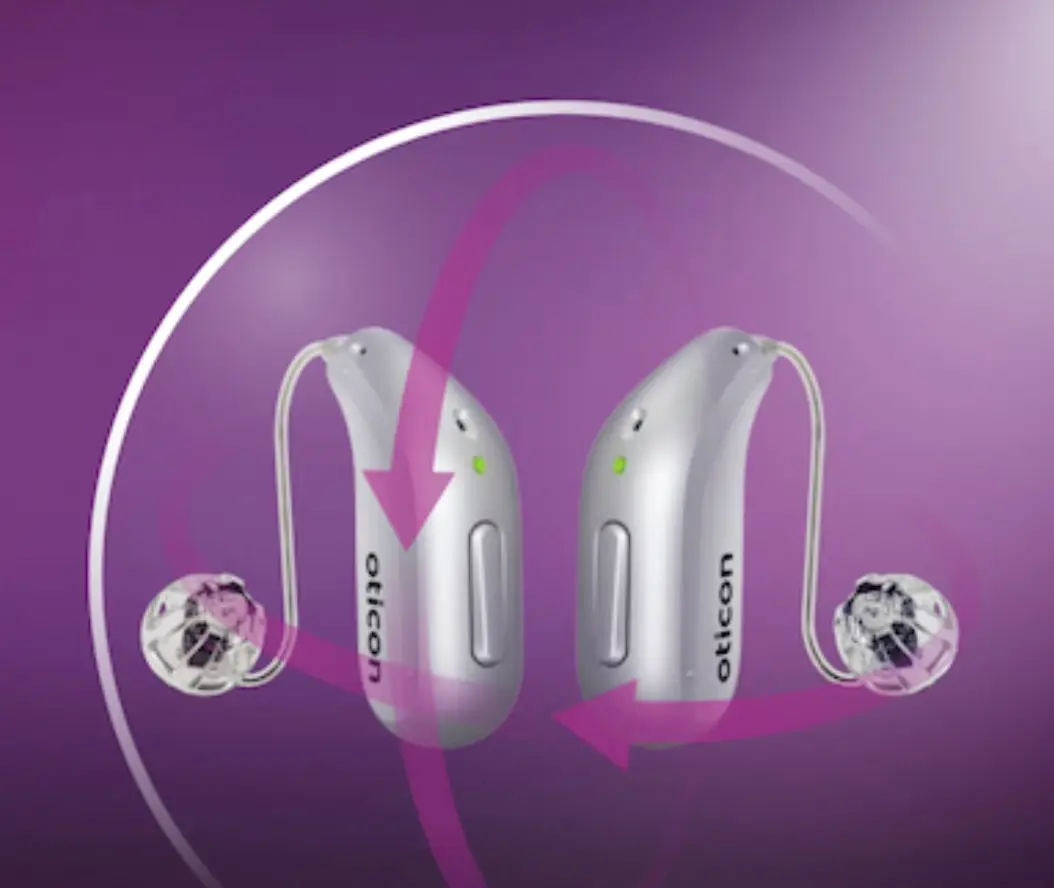
The four sensor dimensions are fused into a single intent signal that steers the MoreSound Intelligence 3.0 processing pipeline, specifically the Intent-based Spatial Balancer and DNN 2.0. The intent signal acts as a high-level prior for the system:
- Moving and scanning: the system biases toward wider spatial awareness, more sound from all directions, less narrowing of focus. The listener needs to hear the environment.
- Still and facing one speaker: the system biases toward more contrast for that speaker, a cleaner signal from the focused direction. The listener is in a focused conversation.
- In complex conversation activity: the DNN 2.0 works harder on speech separation. The intent signal conditions how aggressively.
Oticon reports that the 4D Sensor provides up to 5 dB of additional adaptation within the same acoustic scene compared to a fixed policy based on acoustics alone. This means two situations that look identical to an acoustic classifier, the same noise level, the same room, can receive different processing based on what the listener’s head and body movement indicate they are trying to do.
DNN 2.0: The Neural Network Layer
DNN 2.0 is Oticon’s second-generation deep neural network processing system, trained on 12 million real-world sound scenes. Neural network processing differs from rule-based algorithms in a fundamental way: instead of following programmed rules about what speech sounds like and what noise sounds like, a DNN has learned the statistical patterns of speech across an enormous range of real-world conditions.
- Speech access: Oticon’s technical evaluations show approximately 35% more access to speech cues compared to Oticon Real in matched conditions.
- SNR improvement: the Sirius chip with DNN 2.0 produces approximately 1.5 dB output SNR improvement, with an additional 5 dB span when the 4D Sensor is active.
- Effort reduction: clinical evaluations (internal, N approximately 30, using EEG and VR tasks) showed approximately 15% improvement in speech comprehension in complex cocktail party conditions and evidence of reduced cognitive load.
Evidence note: Oticon’s published data on the Intent and 4D Sensor come primarily from Oticon-authored white papers, technical evaluations, and internal clinical studies, not independent peer-reviewed clinical trials. The methodology is described in detail and the results are consistent, but independent replication in large real-world longitudinal studies is not yet widely available. This is true of most hearing aid manufacturers’ performance claims. We frame this honestly: the evidence is promising and mechanism-aligned, not yet definitively proven by third-party research.
MoreSound Intelligence 3.0: The Complete System
MoreSound Intelligence 3.0 is the processing framework that integrates all Intent platform components:
- 4D Sensor: intent inference from the four inputs described above.
- DNN 2.0: neural network speech-noise separation conditioned by the intent signal.
- Intent-based Spatial Balancer: manages distinct directional sound sources based on intent, wider or narrower depending on what the listener is doing.
- MoreSound Amplifier 2.0: the amplification engine that applies the processing outputs to the acoustic signal.
Oticon Intent vs Previous Platforms
- vs Oticon Real: the Real was the previous flagship. Significant improvements in wind and handling noise over the More. DNN was first generation. No 4D Sensor. Still a strong performer and may be available as a consignment.
- vs Oticon More: the More introduced DNN processing to Oticon. The Intent’s DNN 2.0 builds substantially on this with the 4D Sensor adding the intent layer that More lacked.
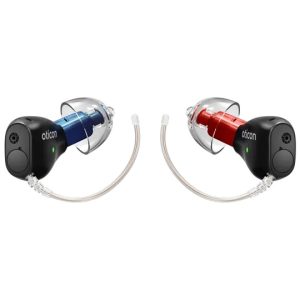
- And Zeal NXT: Zeal runs the same Intent chip and platform in an in-the-ear form factor. Functionally equivalent processing, the difference is form factor, not intelligence.
Intent Platform Telehealth
Oticon Intent supports remote programming through the Oticon Companion app. Setup requires an email address, no physical Remote Link or accessory required. Once registered, your audiologist can make programming adjustments during a remote appointment through the app. Oticon does not offer tinnitus support through telehealth remotely. Hears Hearing & Hearables offers telehealth programming for Oticon Intent through our provider network.
Contact Hears Hearing & Hearables to discuss whether the Intent platform is the right fit for your hearing loss, listening situations, and lifestyle. We carry Intent and offer demonstrations. Pricing is available on request. Oticon does not permit online price display. Read more about Oticon and its history.
Frequently Asked Questions: Oticon Intent and 4D Sensor
What is the Oticon 4D Sensor?
The 4D Sensor is Oticon’s name for the system that fuses four simultaneous inputs, head movement, body movement, conversation activity, and acoustic environment, to infer what the listener is trying to do and adjust hearing aid support accordingly. The sensor data comes from the onboard accelerometer (head and body movement) and acoustic analysis (conversation activity and scene classification). The four inputs produce a single intent signal that conditions the DNN 2.0 processing and the Spatial Balancer.
Is Oticon Intent better than Oticon Real?
The Intent represents a meaningful step forward from the Real. DNN 2.0 is a significant improvement over the first-generation DNN, and the 4D Sensor adds an intent layer that the Real entirely lacks. Oticon’s technical comparisons show approximately 35% more access to speech cues than the Real. For patients who are considering new devices, Intent is the current platform. For patients looking at consignment options, the Real remains a strong performer for everyday listening situations at a lower cost.
What chip does Oticon Intent use?
The Intent platform runs on the Sirius chip, which also powers the Zeal NXT in-the-ear hearing aid. The Sirius chip enables DNN 2.0 processing, 4D Sensor fusion, and Bluetooth LE Audio connectivity.
How does the Intent sensing affect battery life?
The accelerometer-based 4D Sensor is a relatively low-power component. Oticon has not published specific battery life reductions attributable to 4D Sensor use alone. The Intent is a rechargeable platform; daily charging is the standard routine regardless of sensor activity.
💙