Theaters, churches, courtrooms, airports, and lecture halls share a challenge for hearing aid users: the speaker is far away, the room is large, and the acoustics often involve hard surfaces that create echo and reverberation. Even excellent hearing aids struggle in these environments because the microphones sit at ear level, a long distance from the sound source, in a reverberant field.
Hearing loops and FM systems solve this by transmitting the venue’s audio signal directly to the listener, bypassing distance, reverberation, and background noise entirely. They are the most effective assistive listening solutions for large public spaces, and understanding them helps you get more out of every public venue that has them installed.
Hearing Loops: How They Work
A hearing loop, also called an induction loop or teleloop, is a physical wire loop installed around a room or designated area. An amplifier drives the audio signal from the venue’s microphone system through this wire, creating a magnetic field within the loop area. Hearing aids equipped with a telecoil (T-coil) can detect this magnetic field and receive the audio signal directly.
From the user’s perspective: walk into the looped area, switch your hearing aids to the T or MT program, and the venue’s audio arrives directly in your hearing aids — clean, close, and without any additional device. No receiver to carry, no pairing to perform.
The Blue Ear Symbol
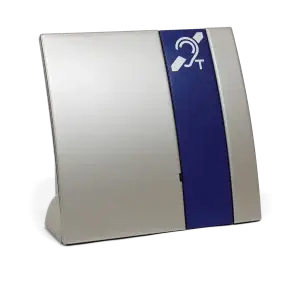
The international symbol for hearing loop access is a blue stylized ear with the letter T. Look for it at ticket counters, information desks, entrances, and seating areas. When you see the blue ear symbol, the area is equipped with a hearing loop compatible with your telecoil. Switch your hearing aids to T or MT mode and you are connected.
Where to Find Hearing Loops
Hearing loops are increasingly common in:
- Theaters and concert halls
- Churches and places of worship
- Airport information counters, gate areas, luggage carousels.
- Courtrooms
- Ticket offices and service counters
- Government buildings and city council chambers
- Some retail service counters and pharmacies
Google Maps now has an online directory of assistive listening venues across the United States, searchable by location and venue type. If you are visiting a new city or looking for looped venues near you, Google Maps is a great starting point.
Telecoil: What It Is and Why It Matters
A telecoil (T-coil) is a small copper wire coil inside a hearing aid that functions as an antenna for electromagnetic signals. Without a telecoil, hearing loops do not work; the hearing aid cannot receive the magnetic signal the loop generates.
- Ask before you buy: not all hearing aids include a telecoil. Smaller hearing aids, many RIC and CIC models, often omit the telecoil to save space. If you attend events in looped venues regularly, confirm that any hearing aid you are considering includes a T-coil before purchasing.
- RIC models without T-coil: some brands offer RIC hearing aids both with and without T-coil. The Widex Moment RIC 13 and similar ’13’ battery models include a telecoil. Rechargeable models from some brands omit it. Ask your audiologist or one of our providers.
- Accessories as workaround: for hearing aids without a built-in telecoil, some brands offer accessories that provide telecoil functionality; the Widex Sound Assist includes a telecoil, for example.
FM Systems: When Loops Are Not Available
FM (Frequency Modulation) systems transmit audio using radio frequencies rather than magnetic induction. They require a transmitter worn by the speaker and a receiver at the listener’s end, either a small receiver that attaches to the hearing aid or one that connects via direct audio input.
- Advantages over loops: portable, not dependent on venue infrastructure, customizable to individual users. An FM system goes anywhere the transmitter and receiver go.
- Educational use: FM systems, particularly the Phonak Roger system, remain the dominant assistive listening technology in classrooms where the speaker’s voice needs to reach a specific student reliably across a large room.
- Signal-to-noise improvement: FM systems can improve the signal-to-noise ratio by 10 to 20 dB compared to unaided listening, more than the 3 to 8 dB improvement from hearing aid directional microphones alone.
- Limitations: require carrying and managing the receiver. More setup than a hearing loop.
Hearing Loops vs FM Systems: Which Is Better
- For public venues with infrastructure, hearing loops are superior — no device to carry, seamless switching, compatible with any T-coil hearing aid regardless of brand.
- For personal and educational use: FM systems are more flexible, portable, and customizable. They work anywhere, not just in looped venues.
- For classrooms specifically: the Phonak Roger system (an FM-based technology) is the most widely validated and used system in educational settings; no other technology matches its track record for student access in classroom environments.
Want to know if your hearing aids have a telecoil, or are you looking for a compatible FM receiver for a venue you attend regularly? Contact Hears Hearing & Hearables, and we can help identify the right solution.
Frequently Asked Questions: Hearing Loops and FM Systems
How do I use a hearing loop with my hearing aids?
Enter the looped area (look for the blue ear with T symbol), then switch your hearing aids to the T (telecoil) or MT (microphone and telecoil mixed) program. The venue’s audio will stream directly to your hearing aids via the loop’s magnetic field. No pairing, no device, just a program switch. If you are not sure how to activate your telecoil program, ask your audiologist to set it up at your next appointment.
Do all hearing aids have telecoils?
No. Many modern hearing aids, particularly smaller RIC models and rechargeable designs, omit the telecoil to save space. If hearing loop access is important to you, confirm any hearing aid you are considering includes a T-coil before purchasing. Some brands also offer accessories that provide telecoil functionality for hearing aids that do not have a built-in coil.
What is the Phonak Roger system and how is it different from an FM system?
Phonak Roger is Phonak’s proprietary wireless microphone system that uses 2.4 GHz digital transmission rather than traditional FM frequencies. It provides the same fundamental benefit as an FM system, the speaker’s voice transmitted directly to the listener’s hearing aids, but with better signal quality, lower latency, and the ability to connect unlimited hearing devices simultaneously. Roger is the dominant system in educational settings. For a full guide to the Roger system see our Roger post.
Where can I find venues with hearing loops near me?
ALDlocator.org is a free, searchable directory of assistive listening venues across the United States. Search by city or zip code to find looped theaters, churches, airports, and other venues near you. When visiting a venue, look for the blue ear with T symbol at entrances, counters, and seating areas.