
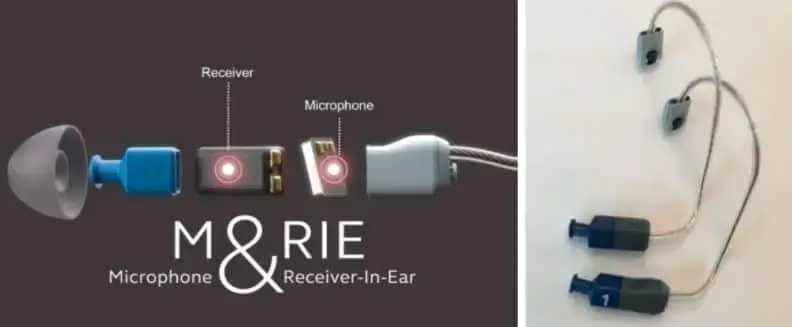
Most hearing aids pick up sound from microphones sitting behind the ear, on top of the ear, or at the ear canal opening. ReSound’s M&RIE, which stands for Microphone and Receiver In Ear, does something fundamentally different: it places a third microphone inside the ear canal itself, alongside the receiver that delivers amplified sound to your eardrum. Read what a receiver is here.
This is not a marketing refinement. It is a genuinely different approach to how sound reaches the hearing aid’s processing chip, and it produces a genuinely different listening experience for the right patient. Understanding what M&RIE actually does, why it matters, and who it suits best is worth the time before deciding whether it is the right choice for your hearing loss.
Why Microphone Placement Matters
The outer ear, which includes the pinna, the concha, and the shape of the ear canal entrance, is not decorative anatomy. It is a precision acoustic structure that evolved specifically to help the auditory system locate sounds in three-dimensional space. The curves and ridges of the outer ear create subtle, frequency-specific reflections that the brain uses to determine whether a sound is coming from in front of you, behind you, above you, or below you. This localization information arrives at the eardrum as a natural modification of the incoming sound before it ever reaches the cochlea.
A standard behind-the-ear hearing aid microphone sits above and behind the ear. It picks up sound before the outer ear has shaped it. The hearing aid then amplifies and delivers that sound into the ear canal, but the natural localization cues the outer ear would have added are gone, replaced by whatever the hearing aid’s processing does to compensate. Every major manufacturer has engineers working on ways to restore or simulate these directional cues through digital processing, and they do it with varying degrees of success.
M&RIE takes a different approach entirely: let the outer ear do what it evolved to do, then pick up the sound after it has already been shaped by the patient’s own unique ear geometry, inside the canal where those localization cues are still present.
What M&RIE Actually Is
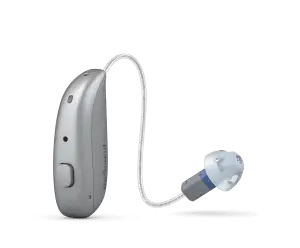
The M&RIE receiver is a physically different component from a standard RIC receiver. In addition to the speaker element that delivers amplified sound, it contains a small inward-facing microphone positioned in the ear canal. This microphone captures sound that has already passed through and been shaped by the patient’s own outer ear, the same sound the eardrum would receive without hearing loss, just quieter.
The ReSound hearing aid uses input from three microphones simultaneously: the two standard microphones on the hearing aid body behind the ear, and the in-ear microphone from the M&RIE receiver. The processing blends these three signals, using the behind-the-ear microphones for directional processing and noise handling, and the in-ear microphone to preserve the natural spatial and localization information that the outer ear already encoded in the sound.
What M&RIE Sounds Like in Practice
The most consistent patient description of M&RIE compared to a standard receiver is that sound feels more natural and more like it is coming from the right place. The spatial accuracy, knowing whether a sound is in front of you, behind you, or to one side, is meaningfully better for many M&RIE wearers than with standard receiver fittings.
Wind noise is also significantly reduced with M&RIE, since the in-ear microphone is sheltered inside the canal rather than exposed on the outer surface of the hearing aid. For patients who spend time outdoors, in cars with windows open, or in any environment with airflow across the ear, this is a practical and audible benefit.
Own voice perception, the way patients hear their own voice through their hearing aids, is another area where M&RIE shows consistent benefit. Because the in-ear microphone captures the natural resonance of the wearer’s own voice as it travels through the skull and ear canal, voices processed through M&RIE tend to sound less hollow or telephone-like than voices processed through behind-the-ear microphones alone.
M&RIE is available on ReSound Sensia, Vivia, Savi, and Nexia platforms at technology levels 9 and 7. It requires a custom fit or a well-fitting standard dome to maintain the microphone’s position in the ear canal. Patients whose ear anatomy does not retain the M&RIE receiver securely may not achieve the full benefit of the in-ear microphone.
Who Benefits Most From M&RIE
- Patients who prioritize natural, spatial sound quality: if hearing aids that sound processed or directionally flat have been a past complaint, M&RIE’s use of the patient’s own ear acoustics directly addresses this.
- Patients with good low-frequency hearing: M&RIE works best for patients who have normal or near-normal low-frequency hearing, since the open fitting required to position the in-ear microphone allows low-frequency sound to enter the ear naturally rather than through the hearing aid. Patients with significant low-frequency loss may not be appropriate candidates.
- Active outdoor patients: the sheltered microphone position dramatically reduces wind noise compared to standard behind-the-ear microphones, making M&RIE a strong choice for patients who walk, cycle, run, or spend significant time outdoors.
- Patients with localization difficulty: patients who report struggling to identify where sounds are coming from, a common consequence of hearing aid use with standard receivers, often show the most dramatic improvement with M&RIE.
- Patients bothered by own voice quality: if the hollow or unnatural quality of your own voice through previous hearing aids has been a consistent complaint, M&RIE’s in-ear microphone captures voice resonance more naturally than any behind-the-ear microphone can.
Who May Not Be the Right Fit for M&RIE
- Patients with significant low-frequency hearing loss: the open fitting required for M&RIE allows low-frequency sound to escape the ear canal rather than being amplified. For patients who need significant low-frequency gain, a closed dome or custom mold without the M&RIE microphone component may deliver better overall amplification.
- Patients with ear canals that do not retain receivers securely: the in-ear microphone is only beneficial when it is consistently positioned inside the canal. If the M&RIE receiver works its way out or sits at the canal opening rather than inside it, the benefit of the in-ear microphone is lost. A stable fit is a prerequisite.
- Patients whose primary priority is noise performance in demanding environments: M&RIE’s three-microphone system is excellent, but in highly demanding multi-talker noise environments, some patients find that the more aggressive directional processing available in standard receiver configurations gives a slight edge in the most challenging conditions. M&RIE prioritizes naturalness; standard receivers can be tuned for more aggressive noise suppression.
M&RIE vs Standard Receiver: Key Trade-offs
- Localization and spatial awareness: M&RIE wins clearly. The use of the patient’s own outer ear acoustics produces directional accuracy that no digital processing can fully replicate.
- Wind noise: M&RIE wins clearly. The sheltered microphone position is a genuine practical advantage for outdoor use.
- Own voice naturalness: M&RIE wins for most patients. The in-ear microphone captures voice resonance differently and more naturally than behind-the-ear microphones.
- Low-frequency amplification: standard receiver wins for patients with significant low-frequency loss. M&RIE’s open fitting requirement limits how much low-frequency gain can be delivered.
- Aggressive noise suppression in demanding environments: slight edge to standard receivers for patients who need maximum directional noise processing in multi-talker situations.
- Fit stability requirement: standard receivers are more forgiving of variable ear canal retention. M&RIE benefits depend on consistent positioning inside the canal.
M&RIE and the ReSound Vivia Platform
M&RIE is available on the ReSound Vivia platform at the 9 and 7 technology levels, and the 2026 new platform, the Sensia, as well as on the Savi and Nexia platforms. It is not available at all technology levels, the processing demands of blending three microphone inputs require the higher-tier platforms.
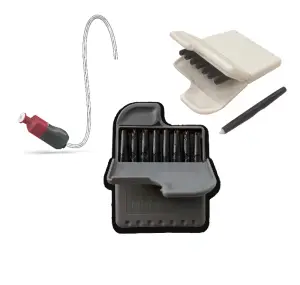
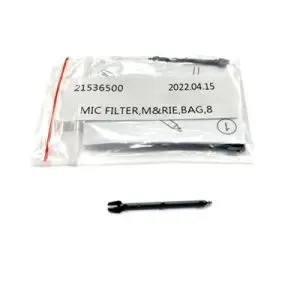
The M&RIE receiver is a distinct component from the standard receiver and uses a different wax guard system called mic filters. M&RIE receivers use dedicated M&RIE mic filters rather than the standard SureFit 3 wax guards used on standard receivers. This is worth confirming when ordering replacement components. For a full breakdown of which wax guards and receivers fit which ReSound models, see our receiver and wax guard compatibility guide.
Interested in trying M&RIE to see whether the spatial and naturalness benefits are audible to your ears? We offer hearing aid demonstrations at Hears Hearing & Hearables that let you compare M&RIE and standard receiver fittings in realistic listening conditions before committing. Contact us to arrange one.
Replacement Parts for M&RIE Receivers
M&RIE receivers use different replacement components than standard ReSound receivers. Ordering the wrong part is the most common M&RIE maintenance mistake. Here is what you need and where each part fits:
M&RIE Mic Filters
The M&RIE mic filter is the wax protection component for the M&RIE receiver. It protects both the speaker port and the inward-facing microphone port. Do not substitute standard SureFit 3 wax guards — they do not fit the M&RIE receiver and will not protect the microphone opening correctly.
- ReSound M&RIE Mic Filter: the correct replacement filter for all M&RIE receivers on Vivia, Savi, and Nexia platforms.
M&RIE Receivers
M&RIE receivers are available in different power levels depending on your degree of hearing loss. Confirm your current power level before ordering, the power level is printed on the existing receiver body.
- ReSound M&RIE Receiver Standard: for mild to moderate hearing loss. [LINK to product]
- ReSound M&RIE Receiver Medium: for moderate to moderately severe hearing loss. [LINK to product]
- ReSound M&RIE Receiver Power: for moderately severe to severe hearing loss. [LINK to product]
Standard SureFit 3 Wax Guards (for non-M&RIE ReSound receivers)
If you have a standard ReSound Sensia, Vivia, Savi, or Nexia receiver without the M&RIE microphone, your replacement component is the SureFit 3 wax guard, not the M&RIE mic filter. See our full receiver and wax guard compatibility guide to confirm which receiver type you have before ordering.
- ReSound SureFit 3 Wax Guard: for standard (non-M&RIE) Sensia, Vivia, Savi, and Nexia receivers.
Domes
M&RIE receivers require a well-fitting dome to maintain the microphone’s position inside the ear canal. The dome type and size affect both comfort and the effectiveness of the in-ear microphone. Your audiologist selects the right dome at fitting; when replacing domes, use the same size and style.
- ReSound domes: available in open, tulip, and power styles in multiple sizes. Confirm your current dome style and size before reordering. With the ReSound Sensia, released in September 2026, a new style of domes are available that look more like a sleeve.
Not sure whether your receiver is M&RIE or standard, or which power level and dome size you currently have? Contact Hears Hearing & Hearables with your hearing aid model and serial number, and we will confirm the correct replacement parts before you order.
Frequently Asked Questions: ReSound M&RIE
What does M&RIE stand for?
M&RIE stands for Microphone and Receiver In Ear. It refers to ReSound’s proprietary receiver design that places both the speaker component (receiver) and a small inward-facing microphone inside the ear canal, alongside the two standard microphones that sit on the hearing aid body behind the ear.
Does M&RIE really sound more natural than a standard hearing aid?
For patients whose ear canal anatomy retains the receiver securely and who have good low-frequency hearing, yes, the difference in spatial accuracy and own voice naturalness is consistently reported as meaningful. M&RIE uses the patient’s own outer ear to shape incoming sound before the in-ear microphone captures it, preserving the natural directional cues that standard behind-the-ear microphones cannot access. Individual results depend on fit stability and hearing profile.
Can I get M&RIE if I have significant hearing loss?
M&RIE is best suited to patients with mild to moderately severe hearing loss who have good low-frequency hearing. The open fitting required to position the in-ear microphone limits how much low-frequency amplification can be delivered, which makes M&RIE less suitable for patients with significant low-frequency loss. Your audiogram will determine whether your hearing profile is a good match for M&RIE or whether a standard receiver configuration better suits your amplification needs.
Is M&RIE available on all ReSound hearing aids?
No. M&RIE is available on ReSound Sensia, Vivia, Savi, and Nexia platforms at the 9 and 7 technology levels. It is not available at lower technology levels or on all ReSound platforms. The M&RIE receiver is a distinct component that uses different wax guard filters than standard ReSound receivers.
What is the difference between M&RIE wax guards and standard ReSound wax guards?
M&RIE receivers use dedicated M&RIE mic filters rather than the standard SureFit 3 wax guards used on standard ReSound receivers. The M&RIE mic filter protects both the speaker opening and the in-ear microphone port. Using the wrong replacement filter will compromise either the sound output or the microphone function. Always confirm whether your ReSound receiver is M&RIE or standard when ordering replacement components. See our full receiver and wax guard compatibility guide for ReSound-specific details.
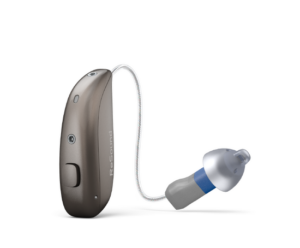
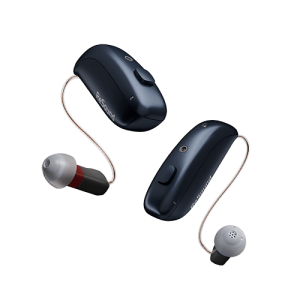
 Technology Levels:



