
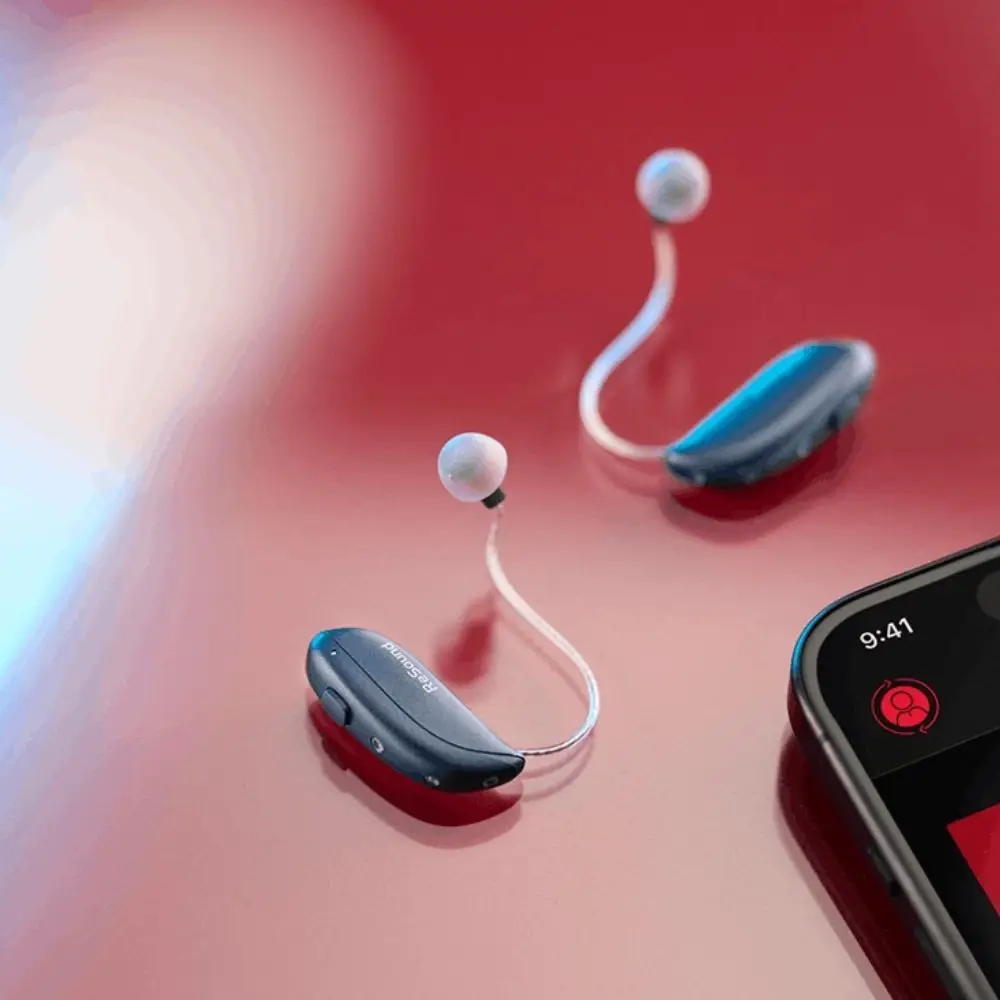
ReSound is a Danish hearing aid manufacturer with one of the most distinctive technological philosophies in the industry. While most hearing aid brands have converged on similar deep neural network approaches to sound processing, ReSound has built its platform on WARP compression, a proprietary system modeled on the biology of the human cochlea rather than conventional digital audio architecture. The result is consistently described as sounding more natural than competing devices.
ReSound also holds a specific distinction as of mid-2026: they are the first and currently the only manufacturer with a fully activated and consumer-ready Auracast implementation, including the world’s first dedicated Auracast Assistant built into the companion app. For patients who want Auracast now rather than as a future promise, ReSound is the clearest answer.
We carry ReSound at Hears Hearing and Hearables and our Hears to U clinic in Hopkins, Minnesota. Here is what the brand actually offers, what makes it distinctive, and who it suits best.
What Makes ReSound Different: Three Genuine Differentiators
WARP Compression: Cochlear Biology as a Processing Foundation
Most hearing aid brands process sound using conventional digital audio architecture with uniformly spaced frequency bands. ReSound’s WARP compression takes a different approach: it maps sound into 17 nonlinearly spaced frequency bands that correspond to how the human cochlea actually processes sound, following the auditory Bark scale.
The practical results are lower processing delay than conventional systems (critical for open-fit devices where natural and amplified sound must arrive in sync), near-zero distortion, and a sound character that patients consistently describe as more natural. This is why ReSound hearing aids perform particularly well for patients who have tried other brands and found them artificial-sounding.
Auracast: First and Most Complete Implementation
ReSound activated Auracast on the Nexia platform in 2023 and launched the Vivia in 2025 with the first dedicated Auracast Assistant in any hearing aid companion app. The Smart 3D app’s Auracast Assistant lets users scan for nearby broadcasts, select the audio they want, and connect with a single tap, without requiring native phone OS support for Auracast. ReSound Sensia carries the same Auracast Assistant forward, so the Auracast experience described here applies to Sensia as well as Vivia.
In our clinic we tested the Vivia’s Auracast implementation and found it to be the easiest-to-use Auracast hearing aid currently on the market. The setup process through the Smart 3D app is genuinely intuitive. We also confirmed that the ReSound Auracast transmitter (TV Streamer+) can broadcast to both ReSound Vivia and Starkey Edge AI hearing aids simultaneously, demonstrating the brand-agnostic potential of the standard.
M&RIE: The Microphone That Changed Open-Fit Sound
ReSound’s M&RIE (Microphone and Receiver In Ear) design places a third microphone inside the ear canal alongside the receiver. Most hearing aids have two microphones on the device body behind the ear. The in-ear microphone captures sound the way the ear naturally receives it, including the acoustic shaping effects of the pinna and ear canal that help the brain locate sounds spatially.
The result is improved spatial awareness, more natural sound localization, and a listening experience that more closely resembles natural hearing rather than amplified sound. M&RIE is available on select Vivia models and represents one of the more clinically meaningful innovations in ReSound’s recent lineup.
The Current ReSound Lineup
ReSound’s current platform is the Sensia launched in 2026. The Vivia (2025) and Nexia (2023) remain available. Both the Savi and the Key round out the lineup at different price points.
| Model | Platform | Position | Auracast | Key Feature |
| Sensia | New AI flagship | Premium | Activated | AcoustIQ classifier, 4-mic beamforming, automatic DNN denoising, Intelligent All-Around at Level 9 rechargeable |
| Vivia | Previous-generation flagship | Premium | Activated | DNN chip at VI9, Auracast Assistant, M&RIE option |
| Savi | Current budget | Entry level | Activated | Essential Vivia-platform features, lower price than Vivia |
| Nexia | Previous generation | Available | Activated | First ReSound with Auracast, still current technology |
| Key | Budget | Entry level | Not activated | Affordable, Bluetooth streaming, good for first-time buyers |
ReSound Sensia: The New AI Flagship
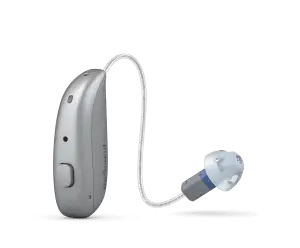
ReSound Sensia is GN’s newest flagship, launched in August 2026 as the successor to Vivia. Rather than simply amplifying the loudest sound in a room, Sensia is built on a new AI platform designed to lift the specific voice a wearer is trying to follow.
The platform combines three technologies working together: AcoustIQ, an environmental classifier that senses the listening situation in real time and engages the right features automatically; 4-microphone directional beamforming that creates a forward-facing beam toward the person a wearer is facing; and automatic deep neural network (DNN) denoising that steps in without the wearer needing to switch programs. GN calls the combination Intelligent All-Around, available at Technology Level 9 in the rechargeable microRIE style. The most important thing to understand is that Intelligent All-Around, the coordinated system that combines the AcoustIQ environmental classifier, 4-microphone beamforming, and automatic DNN denoising, is available only at Level 9 and only in the rechargeable microRIE model.
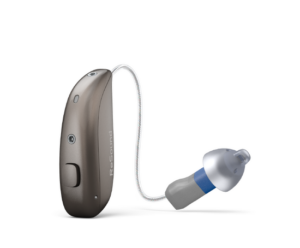
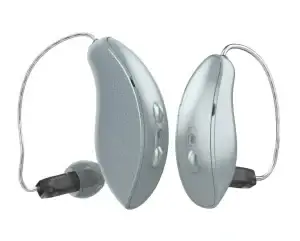
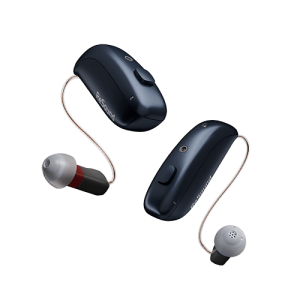
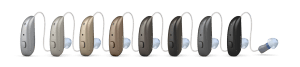
Sensia comes in three styles (rechargeable microRIE, and Classic RIE 61 and RIE 62 for wearers who prefer disposable batteries), 10 colors, and 3 technology levels. It shares its charger and accessory ecosystem with Vivia, so TV Streamer+, Multi Mic+, and Remote Control 3 all work with Sensia. Sensia RIE hearing aids come in two physical shell families. The rechargeable microRIE is the smallest, ReSound’s smallest AI-powered shell, designed to sit as discreetly as possible behind the ear. The Classic RIE comes in two sizes: the 61, sized for a standard 312 battery, and the 62, which is larger still to accommodate both a size 13 battery and a telecoil for connecting to looped phones and venues. Wearers who want the telecoil’s assistive listening compatibility take the size increase as a tradeoff; those who don’t need it can stay with the smaller 61.
We have ordered our first pair for the clinic and will have a demo available for patients who want to try it before deciding. A follow-up post with our hands-on impressions is coming soon.
ReSound Vivia: The Previous Flagship
The Vivia launched in 2025 and at the time and remains a strong current-platform option now that Sensia has taken over the top spot. Its headline feature is a dual-chip architecture: the 360 chip handles ongoing sound processing, while a dedicated Deep Neural Network (DNN) chip powers the Intelligent Noise Tracker for speech enhancement and noise reduction.
The DNN chip in the Vivia was trained on 13.5 million spoken sentences across 3.9 million tuned sound parameters and performs 4.9 trillion operations per day. It is only available at the Level 9 (Premium) technology tier and only in the rechargeable model. Vivia 7 and Vivia 5 use the 360 chip alone without the DNN.
Our clinic impressions of the Vivia: we found it noticeably less occluding and more natural-sounding than previous ReSound models. The open-fit sound character that ReSound’s WARP processing has always delivered is further refined in the Vivia. The Auracast implementation through the Smart 3D app is the most consumer-friendly we have tested across any brand.
ReSound Savi: The Streamlined Alternative
The Savi launched alongside the Vivia as a more accessible option that delivers essential Vivia-platform features without the full AI processing suite. It includes Auracast, Bluetooth LE Audio, Smart 3D app compatibility, and the TV Streamer+ and Multi Mic+ accessory ecosystem. For patients who want current-platform Auracast at a lower price than the Vivia, the Savi is the right conversation.
A Patient Story: Mary
Mary J. is a retired teacher from San Diego, California. She had always been active and social, book clubs, volunteering, staying engaged with former students and colleagues. When her hearing loss became significant enough to affect those connections, she was reluctant to seek help. She had preconceptions about hearing aids that turned out to be about devices from a decade ago. What she found with her ReSound hearing aids was different: natural-sounding, genuinely discreet, and connected seamlessly to her iPhone. She describes the experience of hearing her grandchildren clearly again as one of the most meaningful changes in her recent life.
Mary’s experience reflects what we hear most consistently from ReSound patients: the sound quality registers as natural rather than processed, and the connectivity is reliable enough that the technology fades into the background rather than demanding constant attention.
The GN Family: What You Need to Know About ReSound’s Sibling Brands
GN, ReSound’s parent company, manufactures hearing aids under several brand names. This matters practically because it determines which accessories are compatible with your devices:
- ReSound: the flagship brand; Sensia, Vivia, Savi, Nexia, Omnia, One, LiNX Quattro, Key
- Jabra: GN’s consumer/enterprise audio brand, with some models on the ReSound platform
- Beltone: GN’s franchise retail brand, same ReSound platform technology
- Lively (now Jabra Enhance Select): online-first hearing aid brand, ReSound platform
- Audigy: private label for Audigy Group clinics, ReSound platform
ReSound and Bluetooth: The Connectivity Picture
ReSound hearing aids use Bluetooth LE Audio with MFi for iPhone and ASHA for Android. Current Sensia, Vivia, Savi, and Nexia models all support hands-free calling and direct streaming. Auracast is fully activated across the Sensia, Vivia and Nexia platforms.
ReSound’s HearAdvisor Performance: An Honest Note
Sensia is too new for independent lab testing yet; HearAdvisor has not published a score for it as of this writing. The most recent third-party data point for the ReSound platform is Vivia’s result below. Independent testing by HearAdvisor provides useful third-party perspective. In standardized speech-in-noise testing, the Vivia scored 3.5 out of 5, ranking last among the top 10 hearing aids tested. This is a meaningful data point and worth knowing.
The context: HearAdvisor’s speech-in-noise score measures a specific and important scenario but does not capture everything that determines hearing aid quality. WARP compression’s natural sound character, open-fit performance, Auracast implementation quality, and the M&RIE microphone design are not fully captured by speech-in-noise testing alone. ReSound’s own research shows 64% of Vivia users experiencing better speech understanding in noise compared to other AI-powered hearing aids, and 83% preferring Vivia’s Intelligent Focus — though these are manufacturer-funded figures.
The honest clinical recommendation: if speech in noise in challenging group environments is your primary and overriding concern, the Phonak Infinio Sphere (HearAdvisor number one overall) or Signia IX may serve that specific need better. If natural sound quality, open-fit performance, and best-in-class Auracast are your priorities, ReSound Vivia is a good option.
Who ReSound Is Right For
- Patients who have tried hearing aids and found them unnatural-sounding: WARP compression’s cochlear-biology approach addresses exactly this complaint. Former hearing aid users who gave up on previous devices are among our most successful ReSound outcomes.
- Patients who want Auracast now, not as a future promise: ReSound Sensia, Vivia and Nexia have the most complete and most consumer-friendly Auracast implementation currently available across all brands.
- Open-fit hearing aid users: WARP compression’s low processing delay means amplified and natural sound arrive in sync, avoiding the echo effect that open fittings with slower processors can produce.
- Music listeners: the near-zero distortion and smooth frequency response of WARP compression preserves musical richness and tonal accuracy better than conventional linear compression systems.
- Patients with good hearing at some frequencies: WARP’s nonlinear frequency mapping preserves the natural hearing that remains while amplifying only what is needed, rather than amplifying the whole spectrum uniformly.
- Wearers frustrated by hearing aids that lock onto the wrong voice: Sensia’s AcoustIQ classifier and automatic DNN denoising are built specifically to lift the speech a wearer is trying to follow rather than just the loudest sound in the room.
Not sure whether ReSound is the right brand for your hearing profile? Our team can compare ReSound Vivia with Phonak Infinio, Starkey Omega AI, Oticon Intent, and Signia IX before you decide. Demonstrations are available at our Hears to U clinic in Hopkins, Minnesota. [
Ready to Explore ReSound?
We carry the full ReSound lineup at Hears Hearing & Hearables with transparent unbundled pricing. All prescription ReSound devices require a current audiogram for programming. Remote fitting and follow-up via the Smart 3D app TeleCare is available nationwide.
View ReSound pricing, shop the lineup, or contact our team for a personalized recommendation.
Frequently Asked Questions: ReSound Hearing Aids
What is ReSound’s current best hearing aid?
ReSound’s current flagship is Sensia, launched in August 2026. It combines an AcoustIQ environmental classifier, 4-microphone beamforming, and automatic DNN denoising, coordinated as Intelligent All-Around at the premium Level 9 tier in the rechargeable microRIE style. Sensia comes in three styles, 10 colors, and 3 technology levels, and shares its charger and accessory ecosystem with its predecessor, Vivia, which remains available as a strong current-platform option.
What is WARP compression and why does it matter?
WARP compression is ReSound’s proprietary sound processing system, modeled on the biology of the human cochlea. Instead of dividing sound into uniformly spaced frequency bands like conventional digital systems, WARP maps sound into 17 nonlinearly spaced bands that correspond to how the cochlea actually processes sound. The result is lower processing delay, near-zero distortion, and a natural sound character that patients consistently describe as more realistic than other brands. It is the processing foundation under all current ReSound hearing aids including the Sensia
Does ReSound have Auracast?
Yes, and ReSound currently has the most complete Auracast implementation of any hearing aid brand. The Sensia, Vivia and Nexia both have Auracast fully activated. The Smart 3D app includes the world’s first dedicated Auracast Assistant for hearing aids, making it easier to find and connect to Auracast broadcasts in public venues than any other brand’s current implementation.
What is the difference between ReSound Vivia and ReSound Savi?
Both are current-platform hearing aids with Auracast, Bluetooth LE Audio, and Smart 3D app compatibility. The Vivia was the flagship with the dual-chip DNN design (at Level 9 only), M&RIE microphone option, and the full premium feature set. The Savi provides essential Vivia-platform features including Auracast at a lower price point, without the DNN chip’s advanced AI processing. For patients who want current Auracast capability without paying for the full Vivia premium, the Savi is worth comparing.
Are Beltone and Jabra hearing aids the same as ReSound?
Beltone and Jabra are brands under GN, the same parent company as ReSound, and are built on the ReSound platform technology. Accessories follow the same Auracast-ready vs non-Auracast-ready rule: current Beltone and Jabra models that are Auracast-ready use the same TV Streamer+ and Multi Mic+ accessories as current ReSound models. For a complete compatibility guide, see our ReSound accessories and GN vertical chain post.
How does ReSound compare to Phonak for speech in noise?
HearAdvisor’s independent testing placed Vivia at 3.5 out of 5 for speech in noise, ranking last among the top 10 tested, while Phonak Infinio Sphere ranked first. If speech in noise in complex group environments is your primary concern, Phonak Sphere has a measurable advantage in standardized testing. ReSound’s strengths are natural sound quality through WARP compression, Auracast leadership, and open-fit performance. The right choice depends on which combination of qualities matters most for your specific hearing profile and lifestyle. Our team can help you compare directly.
What is the difference between ReSound Sensia and ReSound Vivia?
Sensia is built on a new AI platform that automatically classifies the listening environment and lifts the speech a wearer wants to focus on, coordinating a classifier, 4-microphone beamforming, and DNN denoising as one system called Intelligent All-Around. Vivia introduced the DNN chip and DNN-based Intelligent Noise Tracker that Sensia builds on. Both share the same hardware platform, so chargers and accessories carry over between them. Sensia is the current flagship; Vivia remains available and continues to be a strong option, particularly for wearers already invested in its accessory ecosystem.
 Technology Levels:



