The Full IX Lineup, What Makes It Distinctive, and Who It Suits
Signia is one of the most technically distinctive hearing aid brands on the market. The lineage goes back to Siemens, one of the oldest and most respected names in hearing care. Today Signia is part of WS Audiology, which also owns Rexton, HearUSA, and Widex, though Widex operates as an entirely separate brand with different processing philosophy.
We carry Signia at both Hears Hearing & Hearables and our Hears to U clinic in Hopkins, Minnesota. It has been a consistent choice for a meaningful portion of our patients, particularly those with high-frequency hearing loss and those who have struggled with the sound of their own voice in hearing aids. This review covers what Signia actually offers, what makes it distinctive, and who it is best suited for.
What Makes Signia Different: Three Genuine Differentiators
Own Voice Processing (OVP)
Own Voice Processing is Signia’s most distinctive feature and the one that matters most for first-time hearing aid users. The single most common complaint from new hearing aid wearers is that their own voice sounds strange, hollow, or like they are talking in a barrel. Traditional hearing aids process the wearer’s voice the same way they process everything else.
Signia’s OVP uses a dedicated processing stream for the wearer’s own voice, treating it independently from all other sounds. The result is a more natural perception of self-sound, which significantly reduces one of the main reasons people abandon hearing aids in the first two months. OVP is available across the IX platform and is now in its second generation, OVP 2.0, in the Active Pro IX.
RealTime Conversation Enhancement (RTCE)
Signia’s IX platform introduced RealTime Conversation Enhancement, a multi-stream processing architecture that tracks multiple speakers simultaneously, even when they are moving. Standard hearing aids use a single directional focus; RTCE creates multiple focus streams covering the entire front hemisphere, analyzes 192,000 data points per second, and adapts 1,000 times per second to changing conversation dynamics.
Independent research showed a 22% improvement in speech understanding in noisy group conversations with RTCE compared to a competing DNN platform, and 86% of participants performed better with Signia IX than the competitor. This is the technology that makes Signia particularly strong for people who struggle with group conversations in noise.
Extended Bandwidth and High-Frequency Clarity
Signia hearing aids process sound up to 12 kHz, a wider bandwidth than many competing devices. This matters most for patients with high-frequency hearing loss, which affects clarity of consonant sounds like s, sh, and f, the sounds most critical for speech understanding. Patients with steeply sloping high-frequency losses have consistently been among our most satisfied Signia users.
The Current Signia Lineup: IX Platform Overview
The Integrated Xperience (IX) is Signia’s current platform, representing their most advanced hearing aid technology. All IX devices share the same core processing including RTCE and OVP. What varies between models is style, connectivity approach, and specific design priorities.
| Model | Style | Best For | Bluetooth | Key Distinction |
| Pure Charge&Go IX | RIC rechargeable | Most users, all-around | MFi + ASHA | Versatile flagship |
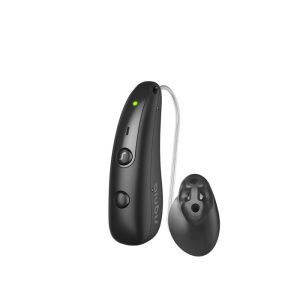
| Pure Charge&Go BCT IX | RIC — smallest BT Classic RIC | Android users, universal connectivity | Bluetooth Classic universal | 36-hr battery, every device |
| Styletto IX | Slim RIC, fashion-forward | Style priority, discreet | MFi + ASHA | Most distinctive design |
| Active Pro IX | Earbud-style RIC | Reluctant first-timers, style-conscious | MFi + ASHA + LE Audio | Looks like premium earbuds |
| Motion Charge&Go IX | BTE power | More significant hearing loss | MFi + ASHA | More power and output |
| Silk Charge&Go IX | CIC rechargeable (standard) | Discretion priority, standard fit | Limited (CIC constraints) | Smallest rechargeable CIC |
| Insio Charge&Go CIC IX | Custom CIC rechargeable | True invisibility, custom fit | App only (no BT streaming) | First custom rechargeable CIC |
Model Deep Dives
Pure Charge&Go IX: The Versatile Flagship
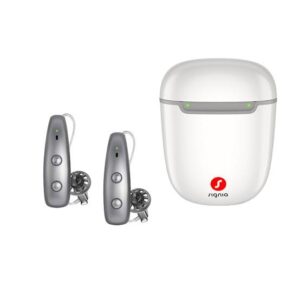
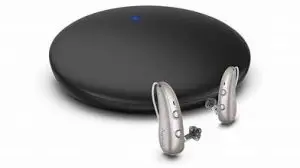
The standard Pure Charge&Go IX is the most commonly fitted Signia device and the right starting point for most patients. Available with the T IX (telecoil included) variant for patients who need loop system compatibility. Full RTCE, OVP, and all IX features. Available in technology levels 7IX (Premium), 5IX (Advanced), and 3IX (Standard). [LINK to S10: Signia pricing]
Pure Charge&Go BCT IX: The Android Champion
The BCT IX is one of the most technically interesting hearing aids on the market. Where most RIC hearing aids use Bluetooth LE (MFi for iPhone, ASHA for Android), the BCT IX uses Bluetooth Classic for universal connectivity, the same approach Phonak uses with their SWORD chip. The result: seamless connection to any Bluetooth device, iPhone or Android, without the compatibility caveats of MFi or ASHA.
It is also the smallest Bluetooth Classic RIC hearing aid available, with 36 hours of battery life including 5 hours of streaming. For Android users who have struggled with connectivity on other hearing aid brands, the BCT IX deserves serious consideration.
Styletto IX: When Design Matters
The Styletto is Signia’s fashion-forward model, with a slim, angular design that is visually distinctive from every other hearing aid on the market. It sits at the top of the ear rather than behind it, making it simultaneously more visible and more intentionally stylish. Available in premium finish colors, including rose gold.
All IX processing features are present. The Styletto uses a proprietary charger that is not compatible with standard Pure chargers. Worth knowing before ordering accessories.
Motion Charge&Go IX: Power and Durability for More Significant Hearing Loss
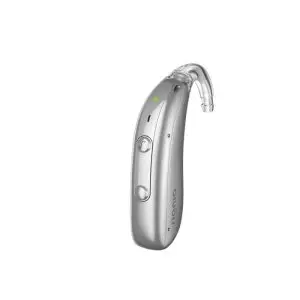
The Motion Charge&Go IX is Signia’s behind-the-ear (BTE) power model, designed for patients with more significant hearing loss who need more output than a receiver-in-canal device can deliver. BTE hearing aids house all components in the body behind the ear rather than using a receiver wire running into the canal, which allows for larger drivers and higher maximum output levels.
All IX platform features are present, including RTCE, OVP, and the full suite of Signia smart features via the Signia app. Available in three sizes, M (medium), P (power), and SP (super power), to match different degrees of hearing loss from moderately severe through profound. The IP68 water resistance rating is particularly valuable in a BTE form factor, as the device’s larger surface area is more exposed to sweat and moisture during active use.
For patients who have been told they need more amplification than a standard RIC device provides, or who have tried RIC devices and found them insufficient, the Motion IX is the right Signia conversation to have. Available in technology levels 7IX, 5IX, and 3IX.
Active Pro IX: The Entry Point for Reluctant Adopters
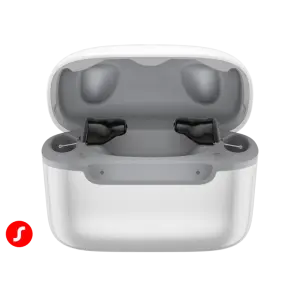
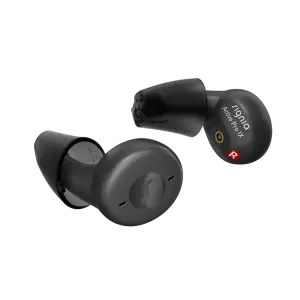
Designed to look like premium consumer earbuds rather than medical devices, the Active Pro IX is Signia’s answer to the stigma barrier. For patients who have resisted hearing aids specifically because of how they look, presenting them with something that resembles an Apple AirPod can be the difference between trying and not trying.
Full IX processing, including RTCE and OVP 2.0. Bluetooth LE Audio with MFi and ASHA. Up to 34 hours battery life. The earbud design means a different fit experience than traditional RIC aids; trying them before buying is strongly recommended.
Silk Charge&Go IX: Discreet Without Custom Fitting
The Silk is a completely-in-canal hearing aid that fits without a custom ear impression, using click sleeves in different sizes. Rechargeable, discreet, and available with the full IX platform. Bluetooth connectivity is limited by the CIC form factor. For patients who want something more discreet than a RIC without committing to a custom fitting process, the Silk is the right discussion to have.
Insio Charge&Go CIC IX: The First Custom Rechargeable CIC
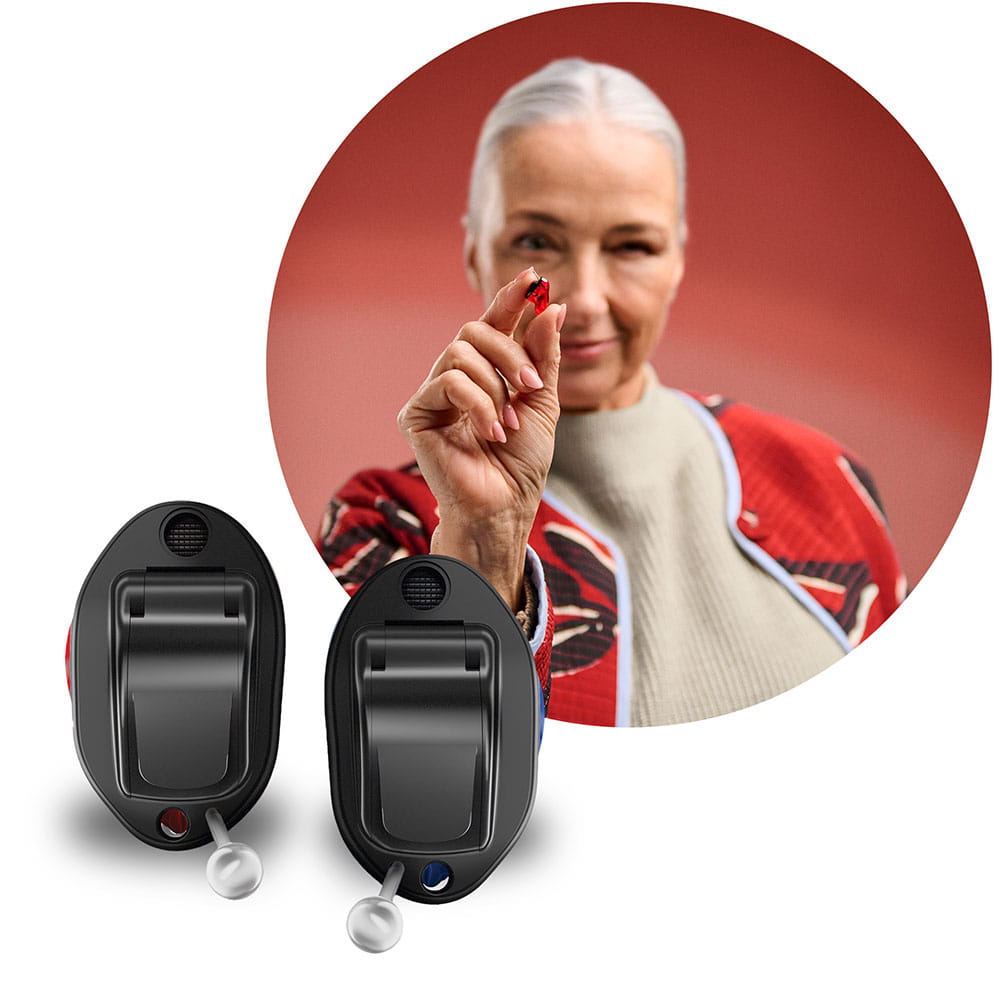
The Insio CIC is a meaningful industry first: a completely-in-canal hearing aid that is both custom-molded to the patient’s ear and rechargeable. Most CIC aids have used disposable batteries because fitting a rechargeable system into such a small shell was not previously achievable. The Insio solves this at the cost of Bluetooth streaming capability, the CIC form factor cannot accommodate a streaming-capable Bluetooth chip. App-based control is available.
WS Audiology Ownership: What It Means for Signia
Signia is owned by WS Audiology, formed by the 2019 merger of Sivantos (Signia’s parent) and Widex. WS Audiology also owns HearUSA, TruHearing, and Audibene, among other entities.
Widex, also owned by WS Audiology, is an entirely different matter. Widex uses completely different processing philosophy (PureSound ZeroDelay, deliberately no DNN), different accessories, and different chargers. Do not assume Signia and Widex products are interchangeable in any way.
Connectivity: Signia’s Approach to Bluetooth
Most Signia IX devices use Bluetooth LE with MFi (Made for iPhone) and ASHA (Android) for direct streaming. The BCT IX uses Bluetooth Classic for universal connectivity. All current IX devices support hands-free calling on compatible phones.
- Auracast status: Signia IX hardware is Auracast-ready via Bluetooth LE Audio. As of mid-2026, activation is pending a firmware update. The October 2025 Connexx myUpdater app released firmware version 25.6.1104.3, which improved LE Audio performance. Full Auracast activation is anticipated.
- Remote care: the Signia App and Rexton App both support TeleCare, allowing audiologists to make real-time adjustments remotely.
- Self-updating: from October 2025, Signia IX owners can install firmware updates themselves via the Connexx myUpdater App, without visiting a clinic.
Own Voice Processing: Why It Matters More Than Most Features
Of all Signia’s features, OVP is the one that most consistently impacts whether a patient actually keeps wearing their hearing aids rather than putting them in a drawer. Here is why:
When a new hearing aid user first puts the devices in, their own voice sounds wrong. Too loud. Hollow. Boomy. Artificial. This is because the microphones pick up bone-conducted self-sound as well as air-conducted external sound, creating an unnatural perception. Traditional hearing aids apply the same processing to the wearer’s voice as to everything else, which does not solve the problem.
OVP creates a separate processing stream specifically for the wearer’s voice, identified by acoustic characteristics unique to speech originating from the wearer’s own larynx. It reduces self-voice amplification without affecting the processing of other sounds. Patients who have tried and abandoned hearing aids from other manufacturers due to voice sound quality are among our most successful Signia outcomes.
Who Signia Is Right For
- High-frequency hearing loss: Signia’s extended bandwidth to 12 kHz makes it a strong choice for patients with steeply sloping losses where consonant clarity is the primary challenge.
- Group conversation challenges: RTCE’s multi-stream architecture is specifically designed for the scenario where multiple people are speaking from different directions. Patients who describe restaurants and family gatherings as their hardest situations.
- First-time users concerned about voice sound: OVP addresses the most common reason new users abandon hearing aids.
- Android users who want universal connectivity: the BCT IX’s Bluetooth Classic approach is the best Android connectivity option in the Signia lineup.
- Style-conscious buyers: the Styletto IX and Active Pro IX offer aesthetics that no other manufacturer matches at the prescription level.
- Patients who want true invisible custom CIC with rechargeability: the Insio CIC is the only option in the market.
Not sure whether Signia is the right brand for your specific hearing profile? Our team can help you compare Signia with Phonak, Starkey, Oticon, ReSound, and Widex before you decide. Demonstrations are available at our Hears to U clinic in Hopkins, Minnesota.
Signia and Rexton: Sister Brands, Different Price Points
If Signia’s pricing is a concern, Rexton is worth knowing about. Rexton uses the same Sivantos processing platform and software as Signia, released approximately six months after each Signia launch. For patients who want the same core technology at a lower price point and are comfortable waiting for the latest platform, Rexton is a legitimate choice.
Ready to Explore Signia?
We carry the full Signia IX lineup at Hears Hearing and Hearables with transparent, unbundled pricing. All prescription Signia devices require a current audiogram for programming. Remote fitting and follow-up via TeleCare is available nationwide.
View Signia pricing, shop the lineup, or contact our team.
Frequently Asked Questions: Signia Hearing Aids
What is Signia’s most advanced hearing aid?
Signia’s current flagship platform is the Integrated Xperience (IX), launched in 2023. The most advanced models on this platform are the Pure Charge&Go 7IX (Premium) and Pure Charge&Go BCT 7IX. The BCT variant adds Bluetooth Classic universal connectivity for better Android compatibility and 36 hours of battery life. The core IX platform includes RealTime Conversation Enhancement, Own Voice Processing 2.0, and processing up to 12 kHz.
What is Own Voice Processing and why does it matter?
Own Voice Processing (OVP) is Signia’s technology for making the wearer’s own voice sound natural rather than hollow or artificial. It uses a dedicated processing stream for the wearer’s voice, identifying it by acoustic characteristics unique to speech from the wearer’s own larynx, and processes it separately from all other sounds. This addresses the most common reason new hearing aid users abandon their devices in the first few months. OVP is available across all current Signia IX models.
What is the difference between Signia and Rexton?
Signia and Rexton are sister brands under WS Audiology, both built on the same Sivantos processing platform. Signia releases new platforms first and is priced higher. Rexton follows approximately six months later with the same core technology at lower pricing, with a simpler aesthetic and naming system. Both use the same software for professional fitting and share many accessories, though TV streamers and remote microphones are brand-specific and not interchangeable.
Does Signia support Auracast?
Signia IX hardware is Auracast-ready via Bluetooth LE Audio. As of mid-2026, full Auracast activation is pending a firmware update. The October 2025 firmware (25.6.1104.3) improved LE Audio performance. When Auracast is activated, Signia IX devices will be able to receive broadcast audio from compatible public venue transmitters.
Is Signia good for Android users?
Most Signia IX devices support Android via ASHA (Android 10 and higher, Bluetooth 5.0 required). For the best Android experience, the Pure Charge&Go BCT IX uses Bluetooth Classic, which connects universally to any Android device without the ASHA version requirements. If Android compatibility is your primary concern, the BCT IX is the Signia model to consider.
What is the difference between Signia IX and Signia AX?
Both platforms use split processing (two separate audio streams for speech and background sound). The IX platform adds RealTime Conversation Enhancement, which tracks multiple moving speakers simultaneously using a multi-stream architecture and analyzes 192,000 data points per second. IX also includes OVP 2.0. In research comparing IX with RTCE to AX without it, 86% of participants performed better with IX in group conversations. AX is the previous generation and is no longer the current platform.