Why There’s No Single “Best”, and How to Find Yours
By Kim Fishman, Audiologist | Hears Hearing & Hearables | Hears to U Clinic, Hopkins, Minnesota
If you’ve been searching online for the “best prescription hearing aid,” you’ve probably noticed something: every list disagrees. One audiologist recommends Phonak. Another swears by Oticon. A third says Starkey. And they’re all credentialed professionals giving their honest opinion.
Here’s the reason: they’re all right for different patients. Prescription hearing aids from the top manufacturers are genuinely excellent devices. The differences between them are real, but they’re differences of sound philosophy, feature emphasis, and fit to individual lifestyle, not differences of good versus bad.
What this means for you as a buyer is both liberating and challenging. Liberating because there’s no wrong answer among the major brands. Challenging because the right answer requires knowing your own hearing profile, lifestyle, and priorities well enough to match them to the right device.
This guide walks through exactly that process, the questions that matter, the factors that should drive your decision, and an honest overview of what each major brand does best. Detailed individual brand reviews are linked throughout for deeper dives.
Why There’s No Single “Best” Prescription Hearing Aid
The major prescription hearing aid manufacturers, Phonak, Starkey, Oticon, Signia, Rexton, ReSound, Widex, and Unitron, are all producing genuinely excellent technology. They compete intensely, they study each other’s products, and the top platforms from each brand consistently rank in independent lab testing as among the best hearing devices available at any price point.
What varies is philosophy and emphasis:
- Sound signature: Widex is renowned for the most natural, musical sound, preferred by musicians and audiophiles. Phonak and Oticon tend toward more aggressive speech processing that extracts clarity from noise at the cost of some environmental naturalness.
- AI approach: Starkey uses generative AI (DNN 360 in Omega AI) that actively steers microphones. Oticon’s Intent uses 4D sensors to adapt to your listening intention. ReSound Vivia processes 4.9 trillion operations per day through a dedicated AI chip. These are different approaches to the same goal, and they produce subtly different listening experiences.
- Feature priorities: Starkey leads in health monitoring and wellness features. ReSound leads in Auracast connectivity. Widex leads in natural sound quality and low processing delay. Phonak leads in universal Bluetooth compatibility.
- Comfort and design: Some patients find certain brands’ physical designs fit their ear anatomy better. The right dome, receiver type, and housing shape matter for all-day wearability, and this is genuinely individual.
The most important factor in hearing aid success is not which brand you choose; it’s whether the device is properly programmed to your audiogram using best-practice fitting protocols, including real-ear measurement. A well-fitted mid-tier hearing aid will outperform a poorly-fitted premium one every time.
The Questions That Actually Drive the Right Choice
In the clinic, we never start with brands. We start with your life. Here are the questions that genuinely matter, and what each answer tells us about which direction to go:
What is your degree of hearing loss?
This is the single most important filter. Prescription hearing aids are designed for mild through profound hearing loss, a much wider range than OTC devices. The severity and pattern of your hearing loss across frequencies determines which technology levels and which features will actually benefit you. A mild, flat hearing loss requires very different processing than a severe, steeply sloping one.
Where do you struggle most?
Noisy restaurants and social gatherings require strong speech-in-noise processing, where Phonak Sphere Infinio, Starkey Omega AI, and ReSound Vivia have all demonstrated strong independent lab scores. Quiet home listening and music appreciation often favor Widex Allure’s natural sound signature. Phone calls and streaming require Bluetooth. Active outdoor lifestyles require waterproofing and durability. The answer to this question drives more of the brand recommendation than anything else.
What technology level fits your lifestyle and budget?
Every major brand offers multiple technology levels, typically basic, standard, advanced, and premium. The differences between levels within a brand are meaningful: higher levels offer more processing channels, a more sophisticated environment detection, and better noise management in complex situations. A person who lives quietly at home and primarily needs to hear television and one-on-one conversation may do perfectly well at a mid-tier level. A person who attends concerts, leads meetings, and travels frequently benefits from premium technology. Budget matters, but so does matching the technology level to your actual lifestyle demands.
What is your relationship with technology?
All premium prescription hearing aids now offer smartphone apps, Bluetooth streaming, and remote adjustment capabilities. But the quality and ease of the app experience vary. Starkey’s My Starkey app is consistently rated as one of the most feature-rich. Phonak’s myPhonak app includes health tracking. Widex’s Allure app offers AI Assistants that draw on crowd-sourced settings from other wearers in similar environments. If you’re not a smartphone user, manual controls are available on most devices, but the optimization capabilities are reduced.
Do you have specific connectivity needs?
Bluetooth streaming, hands-free calling, TV streaming, and Auracast compatibility all vary by brand and model. ReSound was the first to fully integrate Auracast, allowing direct streaming in venues like airports and theaters. Starkey Omega AI and Edge AI are Auracast-enabled via firmware update. Widex Allure supports Bluetooth LE Audio but does not yet have Auracast. Phonak supports universal Bluetooth, one of the broadest compatibility ranges of any brand. Your specific connectivity priorities should be explicit in your device selection conversation.
Have you worn hearing aids before?
First-time users and experienced users need different things. First-timers benefit from a more gradual amplification adjustment, simpler controls, and a forgiving sound profile. Experienced users, particularly those upgrading from a previous brand, know what they liked and didn’t like, and that history should be part of the conversation. We’d always rather know you wore Oticon for ten years and found it too aggressive for music before recommending a replacement than fit you in something that creates the same frustration.
Not sure prescription is right for you yet? Start with our OTC vs. professionally fit comparison.
The Major Prescription Hearing Aid Brands. What Each Does Best
At Hears Hearing & Hearables, we carry all the major prescription brands: Phonak, Starkey, Oticon, Signia, ReSound, Widex, and Unitron. Here’s the honest one-paragraph summary of each. Detailed individual reviews are available for brands where we’ve published them.
Phonak: Universal Connectivity and Speech Clarity
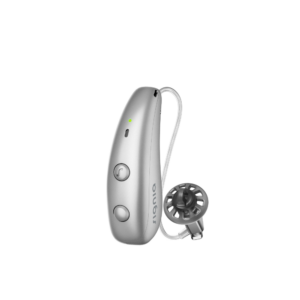
Phonak (part of Sonova, headquartered in Switzerland) is the world’s largest hearing aid manufacturer by revenue. Their Audéo Sphere Infinio is their current flagship, featuring a dual-chip architecture where one chip is dedicated entirely to AI processing for speech separation from background noise. Phonak is consistently praised for universal Bluetooth compatibility, which means they work reliably with a broader range of Android and iOS devices than most competitors. Their AutoSense OS technology automatically adapts to listening environments. Phonak also makes Unitron hearing aids on the same platform, typically at a lower price point. Best known for: speech clarity in noise, universal Bluetooth, broad style range.
Starkey: AI Innovation and Health Monitoring
Starkey is the only major hearing aid manufacturer headquartered in the United States, based in Eden Prairie, Minnesota, just 15 minutes from our Hears to U clinic. Their Omega AI (launched October 2025) introduces DNN 360, the first generative AI deep neural network directionality system in a hearing aid, earning a 4.6/5 HearAdvisor score and Expert Choice Award. Starkey is also the only manufacturer to integrate fall detection, respiratory rate monitoring, and Balance Builder exercises. The My Starkey app is consistently rated among the best in the industry. Best known for: AI innovation, health monitoring, American manufacturing, Minnesota roots.
Oticon: Open Sound Philosophy and 4D Sensors
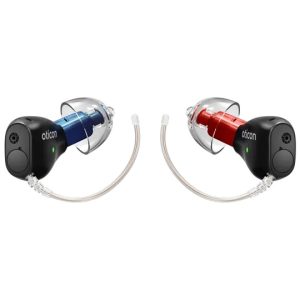
Oticon (part of Demant, based in Denmark) takes a philosophically different approach from most manufacturers. Rather than aggressively focusing on speech from one direction, Oticon’s “open sound” philosophy gives the brain access to the full sound environment, more like natural hearing, and lets the brain do more of the work of focusing. Their Intent, the current flagship, adds 4D Sensor technology that tracks head movement, body movement, conversation activity, and acoustic environment to support natural listening behavior. Independent lab testing has placed Oticon Intent in the top tier of prescription devices. Best known for: natural, brain-friendly sound, 4D sensor technology, open listening philosophy.
Signia: Own Voice Processing and Conversation Enhancement
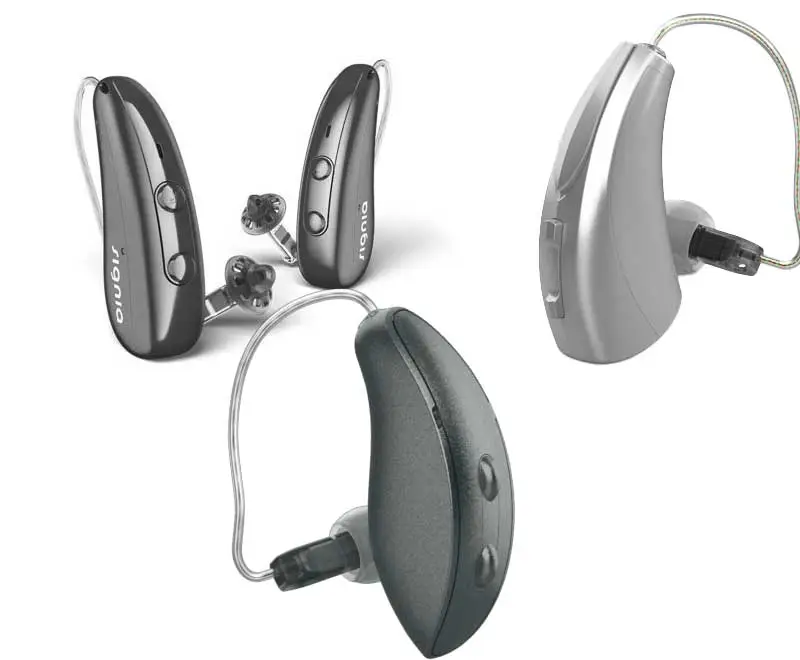
Signia (part of WS Audiology along with Widex and Rexton) is known for two specific innovations that no other brand has matched: Own Voice Processing (OVP), which treats the wearer’s own voice separately from external sounds to reduce the unnatural amplified quality of hearing your own speech, and RealTime Conversation Enhancement, which analyzes conversation in binaural stereo. Their Pure Charge&Go IX, now not the newest of their technology, has a 39-hour battery, IP68 waterproofing, and robust Bluetooth. Best known for: own voice processing, conversation clarity, sleek Styletto design.
Signia’s newest platform, MaX, launched with Acoustic Intelligence, four deep neural networks working together to understand a full listening scene rather than just reducing noise. As of this writing, MaX is available on Signia’s own line and has not yet rolled out to Rexton or other rebranded Signia-platform hearing aids. See our full MaX post for details.
ReSound: AI Clarity and Auracast Leadership
ReSound (part of GN Group, based in Denmark) introduced its Vivia hearing aid at CES 2025, the smallest AI-driven hearing aid from any major manufacturer. Vivia uses a dedicated DNN chip trained on 13.5 million spoken sentences and performs 4.9 trillion operations per day for speech clarity. ReSound was the first company to fully activate Auracast in a production hearing aid, not just “Auracast ready” but fully operational for direct streaming in compatible public venues. Intelligent Focus uses gaze direction (where you’re looking) to prioritize sound. Best known for: Auracast leadership, compact AI design, natural directional hearing.
Widex: Natural Sound and Zero Delay
Widex (also part of WS Audiology) occupies a unique position in the market, they are the brand most associated with natural, high-fidelity sound. Their Allure (launched March 2025) is powered by the new W1 chip (4x faster than previous generation) and features PureSound 2.0 with ZeroDelay technology, processing sound in under 0.5 milliseconds, which virtually eliminates the artificial quality that digital processing can introduce. Widex notably does not use a Deep Neural Network for sound processing (unlike Phonak, Starkey, Oticon, ReSound), a deliberate choice that preserves the natural sound character their users love. Best known for: most natural sound, musicians, audiophiles, minimal processing delay.
Unitron: Value-Tier on the Phonak Platform
Unitron is also made by Sonova (same parent company as Phonak) and runs on the same underlying processing platform. The practical difference is that Unitron offers a more accessible price point, and their Flex:trial and Flex:upgrade programs allow patients to trial technology levels before committing and upgrade later without buying a new device. For budget-conscious buyers who want Phonak-quality processing at a lower cost, Unitron is worth considering. Best known for: Flex trial program, value pricing on Phonak platform, and upgrade flexibility.
Rexton: Value-Tier on the WS Audiology Platform
Rexton is part of WS Audiology, the same parent company as Signia and Widex, which means their underlying technology is closely related to Signia’s premium platform at a more accessible price point. Their current flagship is the Reach, featuring Multi-Voice Focus, a system that scans the surrounding environment 1,000 times per second with four focus beams, adapting automatically to changes in speaker positions and volumes. This makes Rexton Reach particularly strong for group conversations and dynamic listening environments where multiple voices are competing. The Reach R-Li T offers a 39-hour battery life, Bluetooth LE Audio for iOS and Android, and an IP68 waterproof rating, premium specs at a typically lower price than equivalent Signia models. The Rexton app also includes Rexton Assist, which allows patients to get remote support from their hearing care provider without booking an appointment. Best known for: value pricing on WS Audiology platform, Multi-Voice Focus for group conversations, and exceptional battery life.
Why Trying Different Technology Matters More Than Researching It
This is the most important practical advice in this entire guide: reading about hearing aids, including this post, can only take you so far. The only reliable way to know which device works for your ears, in your life, is to try it.
Every major brand has a distinctive sound character. Some patients who expected to prefer the AI-aggressive speech processing of one brand find they actually love the naturalness of Widex. Others who thought they wanted simplicity discover that Starkey’s health features genuinely improve how they move through their day. These preferences only reveal themselves through actual use, not through spec sheets.
At Hears to U clinic in Hopkins, we offer hearing aid demonstration programs for prescription devices. This is exactly the “try before you commit” process the original concept behind this blog describes, and it’s one of the most valuable services we provide.
For online customers through Hears Hearing & Hearables, our telehealth consultation process is designed to guide the selection carefully before purchase, so you’re not buying blind, combined with a return and exchange process if the first device isn’t the right match.
Understanding Technology Levels, Don’t Overpay or Underbuy
Every major brand offers their hearing aids in multiple technology levels, typically three to four tiers, from basic to premium. Within a brand, the same physical device exists at different price points, with the higher levels offering more sophisticated processing.
What higher technology levels typically add:
- More processing channels, allowing finer frequency-specific adjustments
- More sophisticated environment detection, better automatic switching between listening programs
- Better performance in complex, noisy environments; the gap between levels is most apparent in restaurants and social gatherings
- More wireless accessories compatibility
- Sometimes, additional features like health tracking or tinnitus masking options
What higher technology levels don’t change:
- The physical device, same hardware, different software configuration
- Bluetooth connectivity is typically available across all levels
- Basic noise reduction, present at all levels, just more sophisticated at higher tiers
Our honest guidance: match the technology level to your actual lifestyle, not your aspirational one. A premium technology level is worth the investment for someone who frequently navigates complex acoustic environments. For someone whose primary listening environments are quiet, a mid-tier device well-fitted to their audiogram will serve them excellently.
Major Prescription Hearing Aid Brands at a Glance
|
Brand |
Parent Co. |
Current Flagship |
Known For |
Best For |
Minnesota Connection |
|
Phonak |
Sonova (Switzerland) |
Audéo Sphere Infinio |
Universal BT, dual-chip AI |
Speech in noise, broadest phone compatibility |
— |
|
Starkey |
Independent (USA) |
Omega AI |
DNN 360, health monitoring |
Active lifestyles, AI innovation, Minnesota buyers |
HQ in Eden Prairie MN — 15 min from Hopkins ★ |
|
Oticon |
Demant (Denmark) |
Intent |
4D sensors, open sound philosophy |
Natural brain-friendly listening, complex environments |
— |
|
Signia |
WS Audiology (Denmark) |
Pure Charge&Go IX |
Own Voice Processing, RealTime Conversation |
Own voice comfort, conversation clarity, Styletto design |
— |
|
Rexton |
WS Audiology (Denmark) |
Reach |
Multi-Voice Focus, value pricing |
Group conversations, budget-conscious, WS Audiology platform |
— |
|
ReSound |
GN Group (Denmark) |
Vivia |
Auracast, compact AI, Intelligent Focus |
Auracast connectivity, compact discreet design |
— |
|
Widex |
WS Audiology (Denmark) |
Allure |
PureSound ZeroDelay — no DNN (deliberate) |
Natural sound, musicians, audiophiles, minimal processing delay |
— |
|
Unitron |
Sonova (Switzerland) |
Vivante |
Flex trial/upgrade program |
Budget-conscious, Phonak platform, upgrade flexibility |
— |
Ready to Find the Right Prescription Hearing Aid?
The best prescription hearing aid for you is the one that fits your hearing profile, suits your lifestyle, and is properly programmed to your exact audiogram by a professional who takes the time to get it right. That combination- the right device, right fit, right programming- is what produces the hearing outcomes that genuinely change people’s lives.
At Hears Hearing & Hearables, we carry all the major brands discussed in this guide. Our team can help you navigate the choice, coordinate a telehealth consultation, or connect you with our Hears to U clinic in Hopkins for an in-person evaluation and fitting.
Ready to buy? Here’s what you need to know about purchasing prescription hearing aids online.
Contact our team, browse our prescription hearing aid selection, or schedule a telehealth consultation to get started.
— Kim Fishman, Audiologist | Hears Hearing & Hearables | Hears to U, Hopkins, Minnesota
Frequently Asked Questions: Choosing Prescription Hearing Aids
What is the best prescription hearing aid brand?
There is no single best brand; the right prescription hearing aid depends on your specific hearing profile, lifestyle, and priorities. Phonak, Starkey, Oticon, Signia, ReSound, and Widex all produce genuinely excellent flagship devices. The most important factors are: proper audiogram-based fitting with real-ear measurement, the right technology level for your listening environments, and a sound character that matches your preferences. Our team can help you identify which brand and model is the best fit for your situation.
How much do prescription hearing aids cost?
Prescription hearing aids typically range from $2,000 to $7,000 or more per pair, depending on brand and technology level. This price generally includes the devices, professional fitting, real-ear measurement, and follow-up care. Higher technology levels within a brand cost more and offer more sophisticated processing, particularly for complex, noisy environments. Medicare does not cover hearing aids, but many Medicare Advantage plans offer $500–$2,500 per ear in coverage. HSA and FSA funds can also be used.
What is the difference between OTC and prescription hearing aids?
OTC hearing aids are self-fitted devices for mild to moderate hearing loss, available without a prescription. Prescription hearing aids are custom-programmed to your exact audiogram by a hearing care professional, address mild through profound hearing loss, and come with professional fitting and ongoing care. For a full comparison, see our OTC vs Prescription guide.
What is real-ear measurement, and why does it matter?
Real-ear measurement (REM) is a verification step that confirms your hearing aid is actually delivering what your audiogram requires. It’s standard at our Hears to U clinic. See our full fitting standards guide for exactly how it works.
Can I buy prescription hearing aids online?
Yes. At Hears Hearing & Hearables, we sell prescription hearing aids online. Because they require professional fitting and programming, you’ll need a current audiogram. Our telehealth service connects you with our audiologist team for consultation and remote support. For patients in the Hopkins, Minnesota area, in-person fitting is available at our Hears to U clinic.
How do I know which technology level I need?
The technology level should match your actual listening lifestyle. Premium levels offer the most sophisticated noise management and environment detection, genuinely worth the investment for someone who frequently navigates restaurants, meetings, and social gatherings. Mid-tier levels perform excellently in quieter environments and for one-on-one conversations. Our team can help you assess which level makes sense for your specific situation without overpaying for features you won’t use.