
When most people shop for hearing aids, they focus on what they can see: size, color, style, price. But the feature that most directly determines whether you will enjoy wearing your hearing aids is something invisible. The sound processing engine running silently inside the device.
For ReSound, that engine is built on WARP compression, a proprietary technology that has been the foundation of their sound quality for decades and continues to underpin their current Vivia platform. Understanding what WARP compression does, and why it is designed the way it is, gives you a meaningful advantage in evaluating what separates a ReSound hearing aid from the rest.
The Core Problem WARP Compression Solves
Every hearing aid faces the same fundamental challenge: how do you amplify sound in a way that feels natural rather than processed? Most hearing aids address this with conventional digital audio architecture, dividing sound into frequency bands with uniform, evenly spaced intervals, then applying amplification and compression to each band.
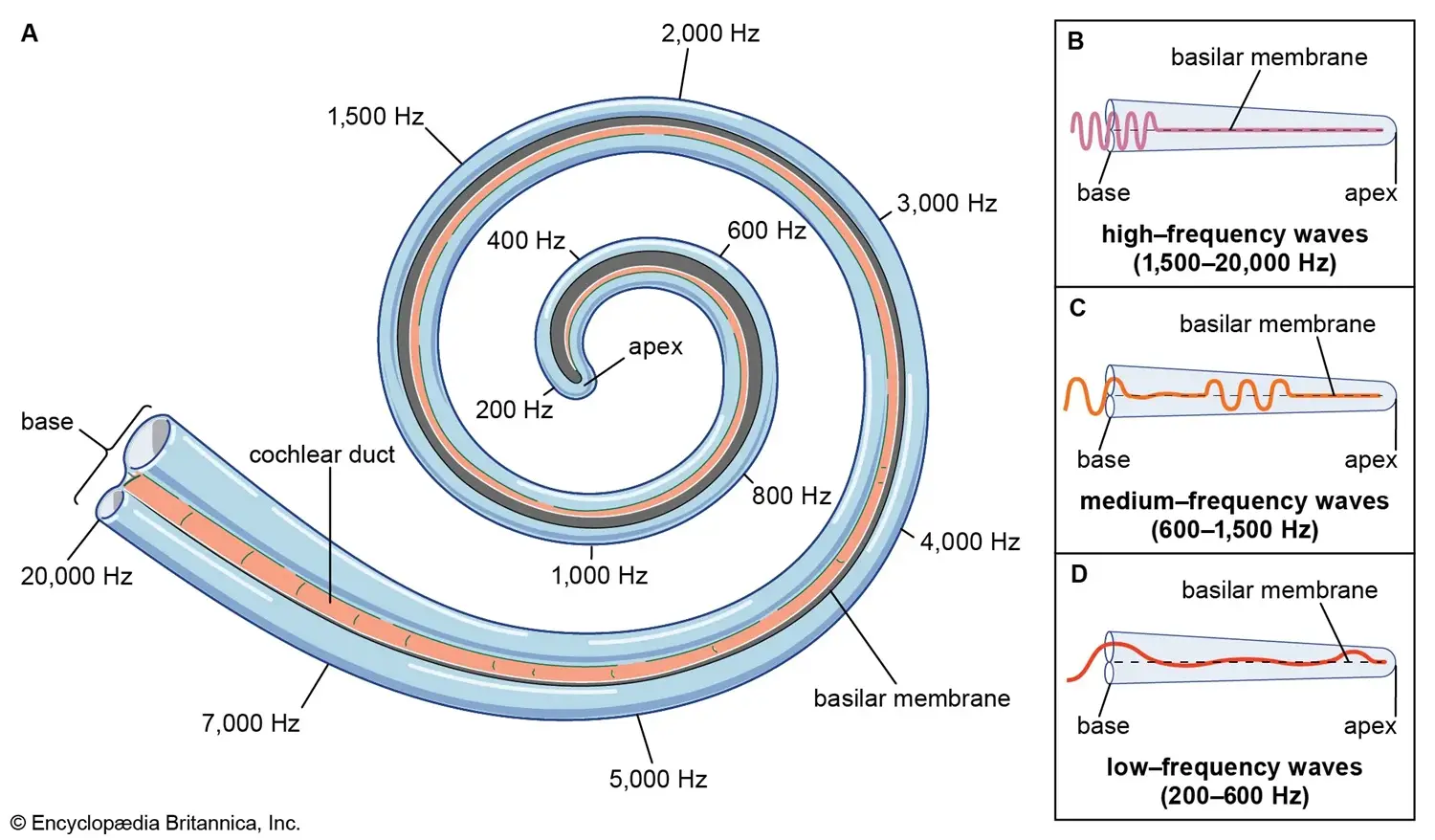
The problem is that the human cochlea does not work that way. The cochlea processes sound tonotopically, meaning different frequencies are processed at different locations along the basilar membrane. The spacing between those frequency regions is nonlinear. High frequencies are compressed into a relatively small area; low frequencies are spread across a larger portion of the cochlea. The auditory system’s resolution is not uniform across the frequency spectrum.
When a hearing aid divides sound into uniformly spaced frequency bands, it is imposing a mathematical grid on sound that does not match how your auditory system actually processes it. The result is a sound that your brain has to work harder to interpret as natural. WARP compression is built to match the grid to the biology rather than the other way around.
What WARP Compression Actually Does
WARP compression maps sound into 17 smoothly overlapping frequency bands. These 17 bands are not uniformly spaced. They are nonlinearly distributed to match the cochlear frequency map and follow the auditory Bark scale. This scale uses the critical bandwidth of the human auditory system as its unit of measurement.
ReSound was the first manufacturer to implement cochlear frequency analysis in its amplification strategy. The system’s 17 bands correspond so closely to the natural auditory filter structure that the center frequencies of the WARP bands are nearly identical to the first 17 bands of the standard auditory model used in hearing research.
The 17-Band System: How It Works
The core of WARP compression is its 17-band architecture. Here is what happens to sound when it enters a ReSound hearing aid:
- Input: the incoming sound signal is captured by the hearing aid microphones.
- Frequency warping: the WARP compressor performs mathematical computations to determine the energy present in each of the 17 nonlinearly spaced frequency bands.
- Band-by-band processing: each band is processed independently with compression settings tailored to the specific characteristics of that frequency region.
- Recombination: the processed bands are recombined into a unified output signal with very low distortion.
- Output: the recombined signal is delivered to the receiver.
The parameters used for frequency warping result in band spacing very similar to that of the human auditory filters. This means the hearing aid is working with a frequency map that closely matches how your brain is already wired to interpret sound, rather than a mathematically convenient but biologically arbitrary map.
Why Low Processing Delay Matters for Open-Fit Wearers
One of WARP compression’s most practically important advantages is its low processing delay. This matters most for patients wearing open-fit or vented hearing aids.
When a hearing aid uses an open dome or a vented ear mold, natural sound travels directly into the ear canal at the same time as amplified sound exits the receiver. If the amplified sound arrives even a few milliseconds later than the natural sound, the brain perceives a disconcerting echo or reverb effect. This is one of the most common reasons new open-fit hearing aid users find their devices uncomfortable.
WARP’s frequency warping approach achieves faster processing than conventional FFT (Fast Fourier Transform) compressors. FFT compressors have high frequency resolution but require more processing time. WARP achieves comparable frequency resolution through the nonlinear band mapping rather than through a high-resolution FFT. This means it can deliver processed sound with minimal delay. The result is that amplified and natural sound arrive in sync at the eardrum. Therefore, the open-fit experience sounds natural rather than hollow.
WARP Compression and Wide Dynamic Range Compression
WARP compression works in close partnership with Wide Dynamic Range Compression (WDRC), the system that ensures soft sounds are made audible without making loud sounds painful or distorted.
In a WDRC system, soft sounds receive more gain than loud sounds. The goal is to restore audibility across the full dynamic range of sound without over-amplifying loud sounds that the residual hearing can already detect. WARP compression achieves WDRC but does so more quickly than a standard FFT compressor and with very low distortion.
The combination of biologically accurate frequency mapping with fast, low-distortion dynamic compression is what allows ReSound hearing aids to handle both a whispered conversation and a loud restaurant with equal composure. This is the clinical description that best captures what WARP processing delivers in practice.
WARP Compression and Noise Reduction
One of the most clinically important applications of WARP’s 17-band architecture is noise reduction. Because the bands are mapped to match human auditory perception at a near-cochlear level, ReSound’s noise reduction algorithms can work with precision.
Noise reduction in ReSound hearing aids operates in the same 17 warped frequency bands as the WARP compressor. Noise estimation is limited to time periods in which speech components are not present. This means the system can reduce noise without disrupting the speech signal it is protecting.
This is why ReSound’s Noise Tracker II system, present across the Vivia product line, can reduce background noise effectively without swallowing the speech sounds the wearer actually wants to hear. The 17 WARP bands give the noise reduction algorithm enough frequency resolution to distinguish between a voice and a background hum with the precision needed to address them differently.
WARP Compression in the ReSound Vivia
The ReSound Vivia continues to be built on the WARP compression foundation while adding a new layer of AI processing on top of it. At the top technology tier (Level 9), the Vivia pairs the 17-channel WARP system with a dedicated Deep Neural Network chip. The two technologies work together: WARP handles the precise, low-distortion frequency mapping and compression that forms the clean signal foundation, while the DNN chip adds an AI layer to identify and separate speech from background noise in real time.
At lower technology levels (Vivia 7 and 5), WARP compression remains active, providing 14 and 12 channels respectively. However, the DNN chip is not present. These levels still benefit from ReSound’s biologically accurate sound processing, with slightly less frequency resolution and without the AI-powered Intelligent Focus feature.
WARP Compression in the ReSound Sensia
The ReSound Sensia also builds on the same WARP compression foundation, adding a new AI layer on top of it. At the top technology tier (Level 9), Sensia pairs the 17-channel WARP system with Intelligent All-Around, the coordinated AcoustIQ classifier, 4-microphone beamforming, and automatic DNN denoising system. WARP still handles the precise, low-distortion frequency mapping and compression that forms the clean signal foundation, while Intelligent All-Around adds the AI layer that classifies the environment and automatically lifts the speech the wearer is trying to follow.
At lower technology levels (Sensia 7 and 5), WARP compression remains active, providing 14 and 12 channels respectively. Intelligent All-Around is not present at these levels. These levels still benefit from ReSound’s biologically accurate sound processing, with slightly less frequency resolution and without the AI-powered classifier and beamforming system.
WARP Compression vs Conventional Digital Compression
|
Feature |
Conventional Digital Compression |
ReSound WARP Compression |
|
Frequency band spacing |
Uniform and linear |
Nonlinear, matched to cochlear anatomy |
|
Model |
Generic digital audio |
Human auditory Bark scale |
|
Number of bands (top tier) |
Varies by brand |
17 overlapping bands |
|
Processing delay |
Can be longer with high FFT resolution |
Minimized by frequency warping approach |
|
Distortion |
May occur at band crossover points |
Near-zero distortion design |
|
Noise reduction precision |
Band-limited by uniform spacing |
Operates in same 17 auditory bands |
|
Sound character |
Can sound processed or tinny |
Natural, cochlea-like reproduction |
|
Open-fit performance |
Echo risk with slower processors |
Low delay keeps natural and amplified sound in sync |
Who Benefits Most From WARP Compression
WARP compression benefits all hearing aid users, but ReSound’s own research and our clinical experience suggest it is particularly impactful for specific patient profiles:
- Previous hearing aid wearers who found them unnatural-sounding:
- Cheaper or older hearing aids with uniform linear compression often produce a tinny or processed quality. WARP’s near-zero distortion and cochlear band mapping addresses this directly. Former hearing aid users who gave up on previous devices are among our most successful ReSound outcomes.
- Open-fit hearing aid wearers:
- The low processing delay of WARP compression means amplified and unamplified sound arrive at the eardrum in sync, therefore avoiding the hollow echo effect that can affect open fittings with slower processors.
- Music listeners:
- The smooth, artifact-free frequency response of WARP compression means music retains its richness and tonal accuracy rather than being flattened by coarse frequency band boundaries. Audiophiles and musicians consistently report this difference.
- Patients with good hearing at some frequencies:
- WARP’s nonlinear frequency mapping preserves the natural hearing that exists while amplifying only what is needed, rather than processing the whole spectrum uniformly.
- Patients who struggle with speech in noise:
- WARP’s 17-band precision gives noise reduction algorithms the resolution to distinguish between speech and background sound at a near-cochlear level, which is why Noise Tracker II can reduce noise without degrading speech clarity.
If you have tried hearing aids before and found them artificial-sounding, a demonstration of ReSound Vivia is worth your time. WARP compression addresses the processing architecture difference that most directly affects the naturalness of the listening experience. Contact our team or visit our Hears to U clinic in Hopkins.
The Bottom Line on WARP Compression
WARP compression rarely gets mentioned in consumer hearing aid brochures, but it quietly underpins everything that makes a ReSound hearing aid sound the way it does. By basing the sound processing engine on the biology of the human cochlea rather than conventional digital audio architecture, ReSound has built a system that handles soft sounds, loud sounds, speech, noise, and music with accuracy as well as naturalness.
In the context of the ReSound Vivia, WARP compression is the clean foundation on which the Environmental Classifier and the new DNN chip operate. Without that accurate signal foundation, even the most sophisticated AI noise reduction would have less to work with.
Frequently Asked Questions: ReSound WARP Compression
What is WARP compression in ReSound hearing aids?
WARP compression is ReSound’s proprietary sound processing system, built on the biology of the human cochlea. Instead of dividing sound into uniformly spaced frequency bands like conventional digital systems, WARP maps sound into 17 nonlinearly spaced bands that follow the auditory Bark scale. Therefore matching how the cochlea actually processes sound. The result is lower processing delay, near-zero distortion, and a sound character patients consistently describe as more natural than other brands.
Why do ReSound hearing aids sound more natural than other brands?
The primary reason is WARP compression. By matching the frequency band structure to human cochlear anatomy rather than conventional digital audio conventions, ReSound hearing aids process sound in a way that more closely mirrors what your auditory system expects. Therefore less cognitive effort is needed to interpret amplified sound as natural. There is also less of the tinny or processed quality that conventional compression can produce.
What is the Bark scale and why does ReSound use it?
The Bark scale is a psychoacoustic scale that reflects the human ear’s critical bandwidth, the frequency resolution of the auditory system at different pitches. It is named after Heinrich Barkhausen. The cochlea has higher frequency resolution at low pitches and lower resolution at high pitches. This is why the Bark scale is nonlinear. ReSound’s WARP compression maps sound into 17 bands using the Bark scale, meaning the hearing aid’s frequency resolution matches what the auditory system itself uses. This is what gives WARP its near-cochlear accuracy.
Does WARP compression work better for music than other hearing aids?
Many musicians and audiophiles report that ReSound hearing aids preserve musical richness and tonal accuracy better than other brands. WARP compression is the technical reason. The smooth, artifact-free frequency response of the 17-band nonlinear system means music is processed without the distortion or frequency smearing that can occur at the crossover points of uniformly spaced band systems.
What is the difference between WARP compression and the DNN chip in the Vivia?
WARP compression and the DNN chip are complementary, not competing, technologies. WARP compression is the core signal processing foundation that handles frequency mapping, compression, and also distortion control. The DNN chip in the Vivia Level 9 adds an AI layer on top of that foundation to identify and separate speech from background noise in real time. WARP provides the clean, accurate signal that the DNN chip then works with. At Vivia Levels 7 and 5, the DNN chip is not present, but WARP compression remains fully active.
Is WARP compression still used in the newest ReSound hearing aids?
Yes. WARP compression is the processing foundation of all current ReSound hearing aids including the Sensia, Vivia, Savi, and Nexia. At the Vivia Level 9, WARP’s 17 channels are paired with a dedicated Deep Neural Network chip. At lower levels, WARP operates with 14 or 12 channels. The DNN chip adds AI processing on top of WARP’s foundation; it does not replace it.
 Technology:



