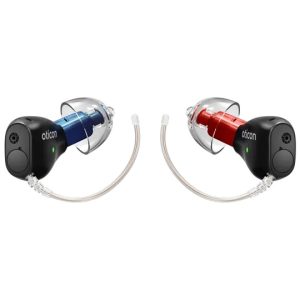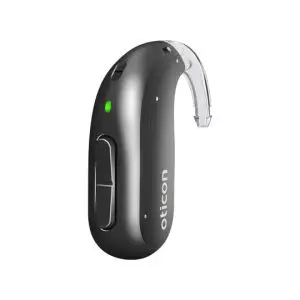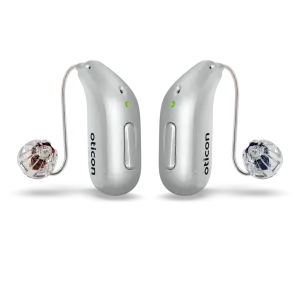
Oticon offers the Intent platform at four technology levels. The hearing aid is physically identical across all four. Same Sirius chip, same 4D Sensor hardware, same rechargeable battery, same Bluetooth LE Audio, same Oticon Companion app, same IP68 waterproof rating, same Tinnitus SoundSupport. What changes between levels is how sophisticated the processing is, and whether that sophistication is audible and meaningful for your specific listening life.
Since this post was written, Oticon has released the Reveal miniRITE R, a newer platform offered in its own three technology levels. The tier breakdown below is specific to Intent; contact us if you’d like the same level of detail on how Reveal’s three tiers compare to each other.
This post breaks down exactly what each level includes, what the real-world differences are, and how to decide which tier your listening situations actually warrant. All feature details are drawn directly from Oticon’s product specification documentation.
What Every Oticon Intent Level Includes
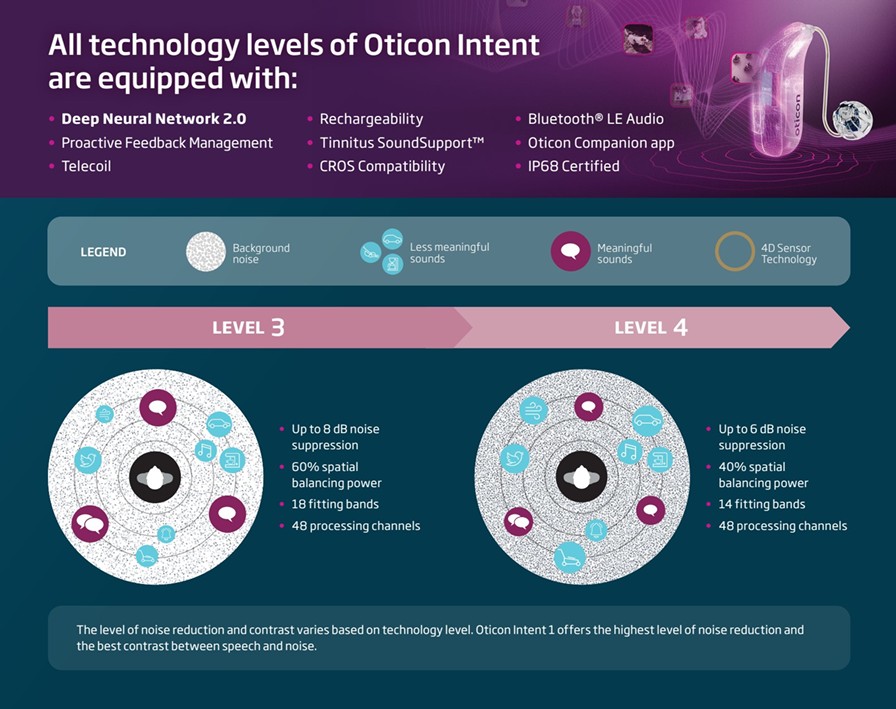
Before getting into what changes, it is worth being clear about what does not change. All four Intent levels include:
- Deep Neural Network 2.0: the onboard AI trained on 12 million real-life sound scenes, present at every level.
- Rechargeability: same battery and charging system across all levels.
- Bluetooth LE Audio: direct streaming to iPhone, iPad, Mac, select Android, and Windows at every level.
- Oticon Companion app: full remote control and telehealth capability at every level.
- Tinnitus SoundSupport: integrated tinnitus sound therapy at every level.
- Telecoil: T-coil access for hearing loops at every level.
- CROS compatibility: for patients with single-sided deafness at every level.
- Proactive Feedback Management: MoreSound Optimizer feedback suppression at every level.
- IP68 waterproof certification: at every level.
No technology level is excluded from the core platform. A patient choosing Intent 4 still gets DNN 2.0, Bluetooth LE Audio, rechargeability, the Companion app, and tinnitus support. What they give up is the depth and sophistication of the automatic sound processing, not the fundamental capability.
What Changes Between the Four Levels
Intent 1: The Full Platform
Intent 1 is the complete expression of the Oticon Intent platform with no compromises in processing depth.
- MoreSound Intelligence 3.0: Level 1, the most sophisticated automatic environment processing, scanning and balancing all sounds in 360 degrees for a full, balanced sound scene with the greatest granularity.
- 4D Sensor technology: active at Intent 1 and 2 only. The sensors detect head movement, body movement, conversation activity, and acoustic environment simultaneously, personalizing noise support in real time based on what the wearer is actually doing.
- Environment classifier: 5 configurations, the widest range of automatically recognized acoustic environments.
- Virtual Outer Ear: 3 configurations, the most spatial realism in sound localization.
- Spatial Balancer: 100 percent, the full spatial balancing power for managing and controlling noise sources even when the wearer is in motion.
- Neural Noise Suppression: up to 12 dB in difficult environments, 6 dB in easy environments, the strongest noise suppression available on the platform.
- Sound Enhancer: 3 configurations for fine-tuning sound quality preferences.
- SuddenSound Stabilizer: 6 configurations for managing sudden loud sounds.
- Clear Dynamics: available at Intent 1 only. Provides an enhanced input dynamic range of 113 dB for better sound quality with less distortion in loud environments.
- Better-Ear Priority: available at Intent 1 and 2 only. Automatically prioritizes the ear receiving the better signal in each listening situation.
- Fitting bandwidth: 10 kHz, the widest available on the Intent platform.
- Processing channels: 64 channels, the highest resolution processing.
- Fitting bands: 24 bands for the most precise audiogram-based programming.
A Note on the Oticon Zeal NXT
The Zeal NXT currently comes in one technology level only, equivalent to the premium Intent 1 tier. There is no mid-level or entry-level Zeal option available at this time. For patients who want the Zeal’s completely-in-the-ear form factor with rechargeable capability and Bluetooth streaming, the decision is simpler than it is for the Intent RIC/BTE lineup, you are getting the full platform feature set, including 4D Sensor technology, 64 processing channels, 24 fitting bands, and up to 12 dB neural noise suppression in difficult environments, without a tier trade-off to navigate. The trade-off with the Zeal is form factor and fit, not technology depth.
Intent 2: Strong Performance With One Key Omission
Intent 2 retains most of the premium platform’s capabilities, including the 4D Sensor technology, which is the most significant feature separating Level 1 and 2 from Levels 3 and 4.
- MoreSound Intelligence 3.0: Level 2, slightly less granular automatic adaptation than Level 1, but still highly sophisticated.
- 4D Sensor technology: active, same as Intent 1. This is an important distinction from Level 3 and 4.
- Environment classifier: 5 configurations, same as Intent 1.
- Virtual Outer Ear: 2 configurations, one fewer than Intent 1.
- Spatial Balancer: 60 percent spatial balancing power.
- Neural Noise Suppression: up to 10 dB difficult, 4 dB easy.
- Sound Enhancer: 2 configurations.
- SuddenSound Stabilizer: 5 configurations.
- Clear Dynamics: not available at Intent 2.
- Better-Ear Priority: available, same as Intent 1.
- Fitting bandwidth: 8 kHz.
- Processing channels: 48 channels.
- Fitting bands: 20 bands.
Intent 3: The Mid-Level Option
Intent 3 is where the 4D Sensor drops out, and the gap between the upper and lower tiers becomes more meaningful. For patients whose listening challenges are primarily in demanding social environments with multiple moving speakers, this is the threshold worth paying attention to.
- MoreSound Intelligence 3.0: Level 3.
- 4D Sensor technology: not available at Intent 3 or 4. The hearing aids still process sound well but do not adapt based on head movement, body movement, or conversation activity detection.
- Environment classifier: 3 configurations, fewer automatic environment categories than Intent 1 and 2.
- Virtual Outer Ear: 1 configuration.
- Spatial Balancer: 60 percent.
- Neural Noise Suppression: up to 8 dB difficult, 2 dB easy.
- Sound Enhancer: 1 configuration.
- SuddenSound Stabilizer: 4 configurations.
- Better-Ear Priority: available at Intent 3, not at Intent 4.
- Fitting bandwidth: 8 kHz.
- Processing channels: 48 channels.
- Fitting bands: 18 bands.
Intent 4: The Entry Level
Intent 4 delivers the core Intent platform at the most accessible price point. Patients still benefit from DNN 2.0, Bluetooth LE Audio, rechargeability, and tinnitus support. The automatic sound processing is less adaptive and less precise than the upper levels, which matters most in complex environments.
- MoreSound Intelligence 3.0: Level 4.
- 4D Sensor technology: not available.
- Environment classifier: not adjustable. The hearing aid runs a fixed classification rather than adapting between multiple automatic environment categories.
- Virtual Outer Ear: 1 configuration.
- Spatial Balancer: 40 percent.
- Neural Noise Suppression: up to 6 dB difficult, 0 dB easy.
- Sound Enhancer: 1 configuration.
- SuddenSound Stabilizer: 2 configurations.
- Better-Ear Priority: not available.
- Fitting bandwidth: 8 kHz.
- Processing channels: 48 channels.
- Fitting bands: 14 bands.
The Two Most Meaningful Differences Between Levels
Reading through all four tiers, two distinctions matter most for real-world patient outcomes:
1. The 4D Sensor Threshold: Level 2 vs Level 3
The 4D Sensor technology is exclusive to Intent 1 and 2. This is the feature that detects what the wearer is physically doing, whether they are turning their head toward a speaker, walking through a crowd, sitting still in a meeting, or engaged in active back-and-forth conversation, and adjusts noise support in real time based on those signals. It is genuinely adaptive behavior rather than reactive processing. For patients who move through varied listening environments throughout the day and want the most automatic, seamless experience, the Intent 1 or 2 tier is the meaningful choice. The gap between Intent 2 and Intent 3 is larger than the gap between Intent 1 and Intent 2.
2. Neural Noise Suppression Range
The difference in maximum neural noise suppression between Intent 1 (12 dB difficult, 6 dB easy) and Intent 4 (6 dB difficult, 0 dB easy) is clinically significant in demanding environments. In a quiet room, this difference is not audible. In a noisy restaurant or a crowded event, up to 12 dB of noise suppression versus up to 6 dB is the difference between following a conversation comfortably and working hard to piece it together. For patients who rarely encounter demanding noise environments, the lower tiers serve well. For patients who regularly eat in restaurants, attend events, or work in open offices, the upper tiers justify their cost difference.
Which Level Is Right for You?
- Intent 1: patients with active social lives, frequent noisy environments, professional settings requiring sustained listening, or anyone who wants the complete platform with no processing compromises. Also best for patients with complex hearing profiles where maximum fitting precision matters.
- Intent 2: patients who want the 4D Sensor’s adaptive behavior at a slightly lower cost than Intent 1, accepting a modest reduction in noise suppression depth and some processing channel resolution. A strong choice for most active hearing aid users.
- Intent 3: patients whose listening challenges are moderate, occasional noise difficulty but not daily demanding environments. The core platform benefits without the 4D Sensor, at a meaningful price difference from Intent 1 and 2.
- Intent 4: patients whose primary listening needs are in quiet or low-demand settings, those on a fixed budget for whom the core platform features (DNN 2.0, Bluetooth, rechargeability, tinnitus support) address their main needs, or patients trialing Oticon’s platform before potentially moving up.
Oticon does not permit online price display, so we cannot list prices for each level here. Contact Hears Hearing & Hearables for current pricing on each Intent level, along with an honest conversation about whether the difference is worth it for your specific listening situation.
Want to hear the difference between Intent technology levels before committing to one? We offer hearing aid demonstrations at our Hopkins, Minnesota clinic and via telehealth. Contact us to arrange one.
Frequently Asked Questions: Oticon Intent Technology Levels
What is the biggest difference between Oticon Intent 1 and Intent 3?
The most significant difference is the 4D Sensor technology, which is present in Intent 1 and 2 but not in Intent 3 or 4. The 4D Sensor detects head movement, body movement, conversation activity, and acoustic environment in real time, adapting noise support based on what the wearer is physically doing. Intent 1 also offers significantly stronger neural noise suppression (up to 12 dB in difficult environments versus 8 dB at Intent 3) and more automatic environment classifications (5 versus 3). In demanding acoustic situations, these differences are audible and meaningful.
Does every Oticon Intent level include Bluetooth and rechargeability?
Yes. Bluetooth LE Audio, rechargeability, the Oticon Companion app, Tinnitus SoundSupport, telecoil, and IP68 waterproof certification are present at all four Intent technology levels. Technology level affects the sophistication of the automatic sound processing, not the fundamental connectivity and hardware features.
Is Oticon Intent 4 a good hearing aid?
Yes, for the right patient. Intent 4 delivers DNN 2.0 processing, Bluetooth LE Audio streaming, rechargeability, and tinnitus support, all of which are genuine, useful features. The trade-offs compared to upper levels are less adaptive noise processing, fewer automatic environment classifications, and lower maximum noise suppression. For patients whose primary listening challenges occur in quiet or low-demand environments, Intent 4 addresses their needs effectively at a lower cost than Intent 1 or 2.
What is the 4D Sensor and why does it only come in Intent 1 and 2?
The 4D Sensor detects four simultaneous data streams: body movement, head movement, conversation activity, and the acoustic environment. Using this information, the hearing aid adapts its processing in real time based on what the wearer is doing, not just what sounds are present. Oticon reserves this feature for the two upper technology levels. For patients whose listening situations involve significant movement, varying attention direction, and multiple competing sound sources, it provides a noticeably more seamless automatic experience than the sensor-absent lower levels.
Can I upgrade my Oticon Intent from a lower level to a higher level later? No. Technology level is set at the point of manufacture and cannot be changed after purchase. If you start with Intent 3 or 4 and later find the noise processing insufficient for your needs, upgrading means purchasing a new device. This is worth factoring in when making the initial decision, particularly if your lifestyle or work situation is likely to change.