Signia has one of the longest and most layered histories in the hearing aid industry. The lineage traces back to Siemens, the German industrial giant, and passes through a 2015 rebranding, a landmark 2019 merger, and three generations of processing platforms to arrive at the current Integrated Xperience technology. Understanding that history helps explain why Signia sits where it does in the market today.
It is also a history that intersects personally with our clinical experience at Hears to U. We have fitted Siemens hearing aids, Signia hearing aids, and Rexton hearing aids through every platform generation. The evolution from one to the next is not abstract for us; it is a clinical history we lived.
Siemens: The Foundation (Pre-2015)
Siemens has a long history of involvement in the healthcare and medical technology sectors. The company’s hearing aid division was a prominent player in the global market for decades, known for quality and technical innovation.
My personal introduction to Siemens hearing aids came after I left my doctoral program at the University of Minnesota around 2000 and began my career as a clinical audiologist in the Twin Cities metro area. During that era, ReSound and Phonak were widely considered the technological leaders. Siemens was a respected name, but not the first choice for most of my colleagues in the early years.
What I recall about Siemens in that period was that the brand carried the credibility of its German engineering heritage and the institutional weight of a global company. Siemens was not a startup or a boutique hearing aid maker. It was a division of one of the largest technology companies in the world, and that identity shaped how it was perceived and how it positioned its products. The trajectory of technology in audiology at that time was anything but static. Just as the BlackBerry had its moment of dominance before being overtaken, the Siemens brand was navigating a rapidly evolving landscape.
2015: The Birth of Signia
In 2015, Siemens made the decision to rebrand its hearing aid division as Signia. The move was not a sale or a divestiture; the company remained the same entity with the same people, technology, and manufacturing. The rebranding was a strategic decision to create a standalone identity for the hearing aid business, separate from Siemens’ broader industrial and technology portfolio.
The name Signia was chosen to signal a fresh identity focused exclusively on hearing care, without the baggage or the associations of the Siemens parent brand. The transition was managed as Sivantos Group, the corporate entity that housed the hearing aid operations before and after the rebrand.
Under the Signia brand, the company continued to develop state-of-the-art hearing aids with a focus on natural listening experience, advanced connectivity, and what would become their most distinctive technology: Own Voice Processing, a dedicated stream for processing the wearer’s own voice separately from all other sounds.
The Innovation Decade: From Nx Through AX
Following the Signia rebrand, the brand moved through several significant platform generations:
Nx Platform
The Nx platform introduced Own Voice Processing in its initial form, the technology that would become Signia’s most distinctive clinical differentiator. OVP addressed the most common reason new hearing aid users abandon their devices: the unnatural perception of their own voice through the aids. Check consignment for used options.
Xperience (X) Platform
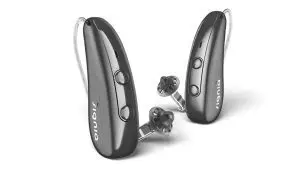
The Xperience platform expanded Signia’s sound processing capabilities with improved environmental classification and the introduction of the Styletto, a slim, fashion-forward hearing aid design that deliberately positioned the device as a lifestyle accessory rather than a medical device. The Styletto remains in the lineup today in its IX iteration. There may be some availability of this technology in the consignment store.
Augmented Xperience (AX) Platform
The AX platform introduced Augmented Focus, Signia’s first implementation of split processing for hearing aids. Split processing separates incoming audio into two distinct streams: one for sounds from the front (typically speech) and one for sounds from behind (typically background noise). Each stream is processed independently and then recombined, allowing different levels of compression and noise reduction to be applied to speech versus background without affecting them equally.
This was a meaningful architectural shift. Previous hearing aids processed all incoming sound through a single path, applying noise reduction uniformly. Split processing allowed the AX to reduce background noise more aggressively without compromising speech clarity, since the speech stream was protected from the same processing. Check for used options of this model.
2019: The WS Audiology Merger
In 2019, Sivantos Group, the corporate parent of Signia and Rexton, merged with Widex, one of the world’s leading hearing aid manufacturers. The merger created WS Audiology, one of the largest hearing care companies in the world.
The WS Audiology name comes from the initials of the two merging entities: W for Widex, S for Sivantos. The merged company brought together Signia, Rexton, Widex, HearUSA, TruHearing, Audibene, and several other brands under one corporate umbrella.
It is important to understand what this merger did and did not change at the product level. Signia and Widex remained distinct brands with distinct processing platforms, distinct accessories, and distinct clinical identities. The merger combined corporate resources, research investment, and distribution infrastructure, but it did not merge the technology. A Signia hearing aid and a Widex hearing aid remain fundamentally different devices with different processing philosophies, different chargers, and different accessories.
What WS Audiology Owns: The Full Picture
Understanding WS Audiology’s portfolio matters for patients navigating the market, because several brands patients encounter are built on Signia or Rexton technology:
- Signia: premium brand, released first on each new platform
- Rexton: value brand, same Sivantos processing platform, released approximately six months after Signia
- HearUSA: a national retail chain that sells Horizon-branded hearing aids built on Signia technology
- TruHearing: insurance benefit administrator, rebranded Signia technology
- Audibene: European online hearing aid retailer
- Widex: operates as a completely separate brand with different processing, accessories, and philosophy
When a patient uses a TruHearing benefit, they are receiving Signia-platform technology administered through a WS Audiology-owned network. When they buy Horizon hearing aids at a HearUSA clinic, they are buying Signia technology. This vertical integration is documented in our ethics series.
2023: The Integrated Xperience Platform
Where AX created two streams (speech and background), IX introduces RealTime Conversation Enhancement (RTCE), which creates multiple dynamic focus streams across the entire front hemisphere. The system analyzes 192,000 data points per second and adapts 1,000 times per second to changing conversation dynamics. In independent research, 86% of participants performed better with Signia IX than with a competing deep neural network device in group conversation settings, with a 22% improvement in speech understanding.
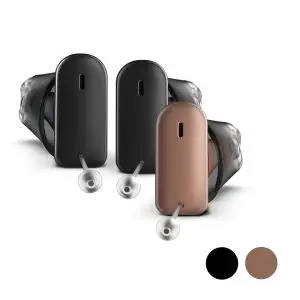
The IX platform has also expanded the lineup in meaningful ways. The Insio Charge&Go CIC IX became the first completely-in-canal hearing aid that is both custom-molded and rechargeable. The Pure Charge&Go BCT IX introduced Bluetooth Classic universal connectivity to the Signia lineup, giving Android users a streaming experience equivalent to what Phonak’s SWORD chip has long offered.
2025: Firmware Updates and Auracast Groundwork
In October 2025, Signia launched the Connexx myUpdater App, allowing IX hearing aid users to install firmware updates themselves from their smartphones without visiting a clinic. The first update through this system (firmware version 25.6.1104.3) improved Bluetooth LE Audio performance, laying groundwork for Auracast activation.
Signia IX hardware is Auracast-ready. Full Auracast activation, which would allow Signia IX hearing aids to receive broadcast audio from public venue transmitters in theaters, airports, and classrooms, is anticipated in a future firmware update.
2026: The MaX Platform
In 2026, Signia introduced MaX, its newest platform and the first meaningful architectural shift since IX. MaX is built around Acoustic Intelligence: four dedicated deep neural networks, Speech Detection, Own Voice Detection, Scene Analysis, and Noise Processing, that share information with each other in real time rather than operating in isolation. The goal is a hearing aid that understands the whole listening moment, not just individual sounds within it.
The RealTime Conversation Enhancement AI in MaX processes 75% more data points per second than the previous IX platform. Own Voice Processing AI recognizes and balances the wearer’s own voice immediately, with no in-clinic calibration required. All of this runs on a new MaX chip, which Signia says delivers 54 times more processing power, 50% greater energy efficiency, and twice the memory of the previous generation.
MaX also introduces OneConnect: a single device that supports Bluetooth Classic, Bluetooth LE Audio, telecoil, and Auracast all at once, rather than requiring different models for different connection types the way the IX platform’s BCT IX and T IX do. Full Auracast functionality is expected to arrive through a Signia One app firmware update by March 2027.
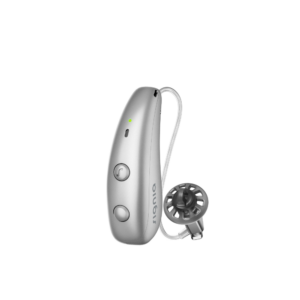
MaX is currently available as the Pure Charge&Go MaX RIC, in technology levels 3, 5, and 7, with up to 30 hours of battery life on a single charge. It has not yet rolled out to Rexton or other rebranded WS Audiology lines, those remain on the IX platform for now. Our team is attending Signia’s official MaX training in September and will update this post with anything meaningful learned there.
After more than a century of hearing aid heritage through the Siemens lineage, Signia continues to be one of the most technically ambitious brands in the industry. From the first OVP to multi-stream RTCE to the first custom rechargeable CIC to Acoustic Intelligence in MaX. Signia’s commitment to solving genuine clinical problems rather than simply adding features has remained consistent across the platform generations.
Frequently Asked Questions: History of Signia Hearing Aids
When did Siemens become Signia?
Siemens rebranded its hearing aid division as Signia in 2015. The corporate entity that housed the hearing aid operations was called Sivantos Group. The rebrand created a standalone identity for the hearing care business separate from Siemens’ broader industrial portfolio. The technology, people, and manufacturing remained the same.
Who owns Signia now?
Signia is owned by WS Audiology, formed by the 2019 merger of Sivantos Group (Signia’s parent) and Widex. WS Audiology is one of the world’s largest hearing care companies and also owns Rexton, HearUSA, TruHearing, Audibene, and Widex, among other brands.
Is Widex the same as Signia?
No. Both are owned by WS Audiology, but they operate as entirely separate brands with different processing platforms, different sound philosophies, different accessories, and different chargers. Widex uses PureSound ZeroDelay processing and deliberately avoids deep neural network processing to preserve natural sound. Signia uses RealTime Conversation Enhancement with multi-stream DNN processing. They are not interchangeable in any way.
What is the difference between Signia AX and Signia IX?
Both platforms use split processing (two separate audio streams for speech and background). Signia IX adds RealTime Conversation Enhancement, which extends this to multiple dynamic focus streams that track moving speakers simultaneously, analyzing 192,000 data points per second and adapting 1,000 times per second. Research showed 86% of participants performed better with IX than with a competing DNN device in group conversation settings. IX also includes Own Voice Processing 2.0 and the extended lineup, including the Insio CIC and BCT IX models.
What is Signia MaX and how is it different from IX?
MaX is Signia’s newest platform, launched in 2026. It’s built around Acoustic Intelligence, four deep neural networks working together in real time, running on a new MaX chip with substantially more processing power than IX. MaX also introduces OneConnect, which combines Bluetooth Classic, Bluetooth LE Audio, telecoil, and Auracast into a single device, removing the need to choose between separate models the way IX’s BCT IX and T IX require. MaX is currently available as the Pure Charge&Go MaX RIC in technology levels 3, 5, and 7; it has not yet expanded to other styles or to Rexton and other rebranded WS Audiology lines.
What is Rexton and how does it relate to Signia?
Rexton is Signia’s sister brand under WS Audiology, built on the same Sivantos processing platform. Signia releases new platforms first, and Rexton follows approximately six months later with the same core technology at lower pricing. Both brands use the same professional fitting software. TV streamers and remote microphones are brand-specific and not interchangeable between Signia and Rexton. However, chargers for equivalent models are often compatible.