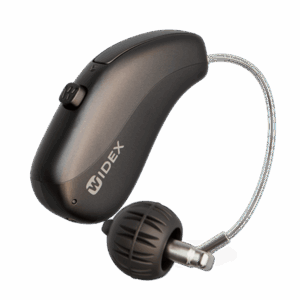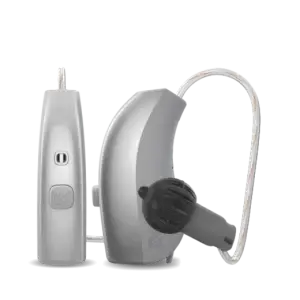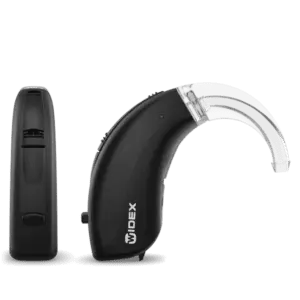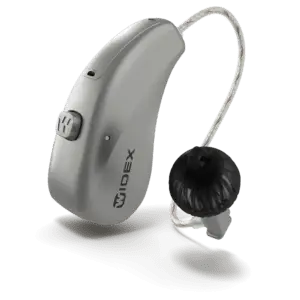
Most hearing aid tinnitus programs use broadband noise, white noise, pink noise, ocean wave modulation to reduce the perceived contrast between tinnitus and silence. Widex took a different approach. Widex Zen uses fractal tones: mathematically generated, semi-random tonal sequences that sound like wind chimes, produced at unpredictable intervals to prevent the brain from habituating to the therapy sound itself.
This distinction matters clinically. A therapy sound the brain habituates to stops working. Fractal tones are designed at a mathematical level to remain novel, maintaining their therapeutic effect over the months of consistent use that tinnitus habituation requires.
What Are Fractal Tones?
Fractal tones are tonal sounds generated by a mathematical algorithm rather than recorded or played back from a fixed source. The key properties that distinguish them from other tinnitus therapy sounds:
- Semi-random generation: the intervals between tones, their pitch relationships, and their timing vary in a mathematically controlled but non-repeating pattern. The brain cannot predict what comes next.
- Non-harmonic structure: fractal tones do not follow the harmonic patterns of music. They sound somewhat like wind chimes or bells but have no musical phrase structure that the brain can learn and anticipate.
- Pleasant quality: despite being non-musical, fractal tones are designed to be pleasant rather than irritating, important for a therapy that requires hours of daily use over months.
- Unpredictability prevents habituation: the same mechanism that causes problems in tinnitus, the brain habituating to and then ignoring a repeated sound, would also cause a fixed therapy sound to become ineffective. Fractal tone variability prevents this.
Fractal tones are not music and not white noise. They occupy a therapeutic middle ground: tonal enough to be pleasant and engaging, variable enough that the brain cannot tune them out. This is the fundamental design rationale behind Widex Zen and its successor, Widex SoundRelax.
The Research Behind Widex Zen Fractal Tones
Herzfeld, Ciurlia-Guy, and Sweetow — Hearing Review, 2014
The foundational clinical trial on Widex Zen Therapy was published in Hearing Review (November 2014) by Melanie Herzfeld, AuD, Enza Ciurlia-Guy, and Robert Sweetow, PhD, across two tinnitus clinics in New York and Ontario, Canada.
Twenty-four subjects with clinically significant tinnitus (Tinnitus Handicap Inventory score greater than 18) completed the six-month study. Results showed a mean reduction of 30 points in THI scores (23 points after only two months) and 28 points in TFI scores (25.5 points after only two months). Critically, 74% and 75% of subjects achieved clinically significant changes in their THI and TFI scores, respectively. The authors concluded that a combination of fractal tones, amplification, and counseling has significant potential for tinnitus patient management.
Herzfeld, M., Ciurlia-Guy, E., & Sweetow, R. (2014). Clinical trial on the effectiveness of Widex Zen Therapy for tinnitus. Hearing Review, 21(11).
Sweetow, Kuk, and Caprioli — Hearing Review, 2015
A subsequent controlled study examined whether fractal tones provided benefit even for patients with minimal hearing loss who did not require amplification, a clinically important question since many tinnitus sufferers have normal or near-normal audiograms.
Subjects using the Widex Zen2Go tinnitus device (fractal tones without amplification) showed an average reduction of 20 points on the TFI after two months, with improvements continuing through six months. The control group, which received only instructional counseling, showed no significant improvement. The study demonstrated that fractal tones alone, without the amplification benefit, produce clinically and statistically significant tinnitus relief. This is particularly important for the estimated 20% of tinnitus sufferers who have normal hearing thresholds.
Sweetow, R., Kuk, F., & Caprioli, S. (2015). A controlled study on the effectiveness of fractal tones and Widex Zen Therapy on subjects with minimal need for amplification. Hearing Review, 22(9), 30-36.
Widex SoundRelax Study — Hearing Review, 2023
In 2023, Widex published interim results from an ongoing study of SoundRelax, their next-generation evolution of the fractal tone approach introduced with Zen.
The study enrolled patients with at least some degree of hearing loss and tinnitus ranging from mild to severe. All participants were fitted with hearing aids containing SoundRelax tones, with follow-up questionnaires at one, two, and four months and six and twelve-month follow-ups continuing. Interim results showed significant improvement in tinnitus severity within the first month of treatment, with continued improvement trending over time. Patient ratings for relaxation, concentration, mood, and overall well-being were high. SoundRelax introduced eight new sounds including relaxing music-like tones, wave-like sounds, and combination soundscapes, expanding the Zen fractal approach.
Helmink, D. (2023, May). New Widex study on fractal sound stimulation in hearing aids shows positive effects for tinnitus treatment and overall well-being. PR Newswire / Hearing Review.
Widex Zen Therapy: The Four Components
Widex Zen Therapy is not just the tones, it is a structured four-component program designed around what is known about tinnitus distress:
- Counseling: both instructional (educating the patient about tinnitus and habituation) and adjustment-based (addressing emotional responses and negative tinnitus cognitions through cognitive and behavioral techniques). This is the component most strongly supported by evidence across all tinnitus interventions.
- Amplification: for patients with hearing loss, amplification reduces the auditory deprivation that contributes to tinnitus. The brain receives more acoustic input, reducing the over-activation that generates phantom sound.
- Zen acoustic options: fractal tones in multiple styles, plus broadband and filtered broadband noise as alternatives. The tones are delivered at a level just audible in quiet environments, designed to relax as well as stimulate.
- Relaxation strategies: sleep management and relaxation exercises addressing the anxiety and stress component of tinnitus distress. Tinnitus is significantly worsened by stress, and sleep disruption is one of the strongest predictors of tinnitus severity.
The appropriate components are tailored to each patient. Patients with more severe tinnitus distress receive more components. Those whose primary symptom is sleep disruption receive sleep-focused intervention. While patient’s without hearing loss can use fractal tones alone, as the Sweetow et al. study demonstrated.
Widex SoundRelax: The Current Evolution
Widex SoundRelax, introduced in 2023, builds on the Zen fractal approach with eight new sounds including relaxing music-influenced tones, wave-like sounds, and combination soundscapes. Available on current Widex Allure and Moment platforms, SoundRelax is designed for all hearing aid wearers, not only those with tinnitus, as a tool for stress reduction and relaxation alongside tinnitus management.
The SoundRelax study found high wearer ratings for relaxation, concentration, and mood, extending the clinical value of the fractal approach beyond tinnitus-specific outcomes.
Who Benefits Most From Widex Zen
- Patients who find broadband noise therapy unpleasant: fractal tones have a more pleasant quality than white or pink noise for many patients. This improves compliance, which is essential for habituation therapy that requires months of consistent use.
- Patients without significant hearing loss: the Sweetow et al. study demonstrated fractal tones produce benefit even without amplification, making Widex Zen appropriate for tinnitus patients who would not otherwise be hearing aid candidates.
- Both tonal and non-tonal tinnitus: unlike Signia Notch Therapy which requires a specific tinnitus pitch, fractal tones work across tinnitus types. Patients with non-tonal tinnitus (humming, crackling) can benefit from Zen therapy.
- Patients whose tinnitus has a strong stress or anxiety component: the relaxation properties of fractal tones and the WZT relaxation strategies address the stress-tinnitus cycle directly.
Widex Zen vs Signia Notch Therapy: Choosing Between Them
Both approaches have strong research support. The clinical distinction:
- Choose Signia Notch Therapy if: the patient has clearly tonal tinnitus at an identifiable pitch, prefers an inaudible passive therapy, or finds audible sound therapy fatiguing. Notch Therapy runs silently with no conscious patient engagement.
- Choose Widex Zen if: the tinnitus is non-tonal or difficult to pitch-match, the patient finds noise therapy unpleasant and would prefer tonal therapy, or relaxation benefits alongside tinnitus management are a priority.
- Both can be considered if: the patient is open to a device change or has not yet committed to a brand. The choice between Signia and Widex involves the full hearing aid fitting, not just the tinnitus program.
If tinnitus is a significant factor in your hearing aid decision, the brand and tinnitus program approach should be part of the conversation before purchase, not an afterthought. Contact Hears Hearing & Hearables or our Hears to U clinic in Hopkins, Minnesota to discuss which tinnitus approach is best matched to your specific presentation.
Frequently Asked Questions: Widex Zen Fractal Tones
What are Widex Zen fractal tones?
Widex Zen fractal tones are mathematically generated semi-random tonal sequences delivered through Widex hearing aids as tinnitus therapy. They sound somewhat like wind chimes but have no repeating musical structure. The mathematical variability is deliberate — it prevents the brain from habituating to the therapy sound itself, which would reduce its effectiveness over time. Fractal tones are designed to be pleasant enough for hours of daily use while remaining novel enough to maintain therapeutic effect.
Does Widex Zen therapy work for tinnitus?
Multiple clinical studies support its effectiveness. Herzfeld, Ciurlia-Guy, and Sweetow (Hearing Review, 2014) found mean THI score reductions of 30 points over six months, with 74 to 75% of subjects achieving clinically significant improvement. Sweetow, Kuk, and Caprioli (Hearing Review, 2015) demonstrated that fractal tones produce significant tinnitus relief even without amplification, with 21-point TFI improvements in two months in patients with minimal hearing loss. Widex SoundRelax interim data (2023) showed significant improvement within the first month of treatment.
Is Widex Zen different from white noise therapy?
Yes, meaningfully different. White noise is a static, constant broadband sound. Fractal tones are non-repeating, tonal, and variable — designed to remain novel to the auditory system over time. For patients who find white noise unpleasant, fatiguing, or ineffective, fractal tones offer a clinically supported alternative. The two approaches also have different mechanisms: broadband noise reduces the tinnitus-silence contrast, while fractal tones promote habituation through ongoing acoustic engagement.
Can Widex Zen help tinnitus patients who do not have hearing loss?
Yes. The Sweetow, Kuk, and Caprioli (2015) controlled study specifically investigated patients with minimal hearing loss who did not require amplification. Subjects using fractal tones alone, without amplification, showed statistically and clinically significant TFI improvements of 21 points in two months, compared to no significant improvement in the counseling-only control group. This makes Widex Zen appropriate for the roughly 20% of tinnitus sufferers who have normal hearing thresholds.
What is Widex SoundRelax and how is it different from Zen?
Widex SoundRelax is the evolution of the Zen fractal tone approach, introduced in 2023 on Widex Allure and Moment platforms. It introduces eight new sounds including relaxing music-influenced tones, wave-like sounds, and combination soundscapes, expanding beyond the original Zen tone styles. SoundRelax is also designed for all hearing aid wearers for general relaxation and stress reduction, not exclusively for tinnitus patients. Early study results show significant tinnitus improvement within the first month and high ratings for relaxation, concentration, and mood.