Personal Sound Amplifiers: Pocket Talker, Trihear, and Who They Suit Best
A personal sound amplifier is not a hearing aid. It cannot be programmed to a specific audiogram, it does not address the precise pattern of frequencies you have lost, and it does not meet the FDA’s definition of a medical device for treating hearing loss. What it can do is amplify specific sounds in specific situations, simply, affordably, and without a clinic visit or prescription.
For the right patient in the right situation, a personal sound amplifier is genuinely useful. Understanding when one is the right tool, and when it is not, helps patients make the best choice.
When a Personal Sound Amplifier Makes Sense
- Patients not yet ready for hearing aids: whether due to cost, stigma, or simply wanting to try amplification before committing to a hearing aid, a PSAP provides a lower-stakes starting point.
- Patients for whom hearing aids are impractical: patients with dementia, stroke, or other conditions where managing a programmable hearing aid is difficult may benefit significantly from a simple amplifier that requires no maintenance or adjustment.
- Situational difficulty only: patients who hear well in most environments but struggle specifically in one-on-one quiet conversations, TV listening, or small group settings may not need a full hearing aid for their daily life.
- Healthcare and caregiving settings: a clinician or caregiver using a personal amplifier to ensure a patient or client hears instructions clearly, without the patient needing to own any device.
- Patients waiting for a hearing evaluation: a PSAP can bridge the gap for someone who knows they have difficulty but has not yet had a formal audiogram.
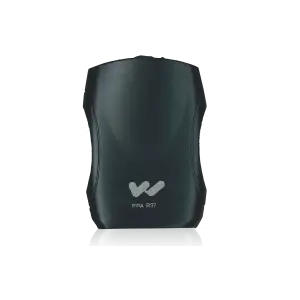
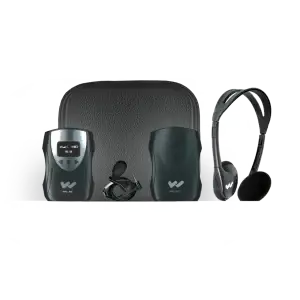
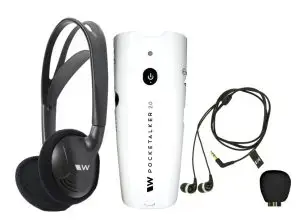
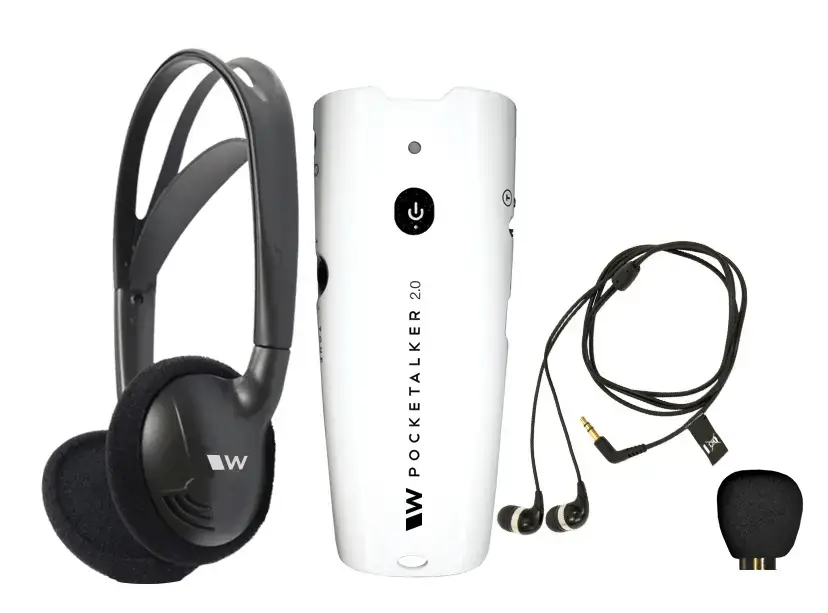
Williams Sound Pocket Talker 2.0
The Pocket Talker 2.0 is one of the most trusted personal sound amplifiers on the market, and one we have recommended to patients for years. It is simple, reliable, and comes with features that distinguish it from generic amplifiers.
- Best use: one-on-one and small group conversations. The microphone works best within six feet of the speaker. A 12-foot extension cord allows the external omnidirectional microphone to be placed across a table in a group setting.
- TV use: place the microphone near the TV speakers and hear the audio directly through the earphones, without increasing room volume for others.
- Volume and tone control: five volume levels and a tone wheel that adjusts bass and treble independently, giving the user some control over the frequency balance.
- Balance control: inside the battery compartment, a balance control sends more amplification to one side, useful for patients with asymmetric hearing loss or single-sided difficulty.
- T-coil button: an external telecoil button allows the Pocket Talker to connect to hearing loop systems in venues, even for users without hearing aids or for hearing aid users whose aids do not have a telecoil. [LINK to A5: hearing loops]
- Battery: two alkaline batteries included, lasting approximately 100 hours. Rechargeable batteries compatible.
- Warranty: five years.
Shop Williams Sound Pocket Talker 2.0
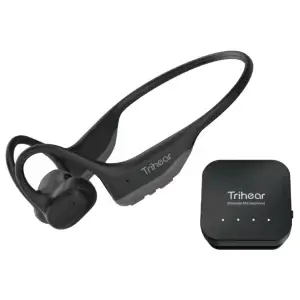
Trihear Liber and Trihear More
Trihear produces personal sound amplifiers designed specifically with hearing-impaired users in mind, combining remote microphone capability with a comfortable open-ear design and wireless connectivity. We carry two models.
Trihear Liber
The Trihear Liber is a wireless personal amplifier with a separate remote microphone that can be placed near a speaker or TV, or worn by a conversation partner, and streams audio wirelessly to the ear unit. Open ear domes keep the ear canal unoccluded for comfort during extended wear.
- Remote microphone range: up to 30 meters, suitable for larger rooms, lectures, and family gatherings.
- Volume control: individual volume adjustment for each ear.
- Tone control: five levels of tone adjustment for personalized frequency balance.
- Battery: 10-minute charge for 6 hours of use; full charge for up to 24 hours.
- Best for: patients who want remote microphone capability in a simple, non-medical device.
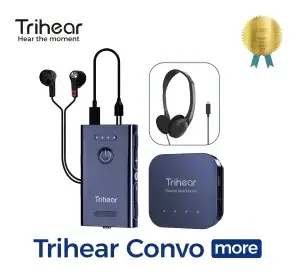
Trihear More
The Trihear More provides higher amplification for patients with more significant hearing difficulty, while maintaining the same open-ear comfort and wireless remote microphone design as the Liber.
- Amplification: nine volume levels, sufficient for patients with more than mild hearing difficulty.
- Best for: patients who need more amplification than standard PSAPs provide but are not ready for or suited to prescription hearing aids.
Personal Sound Amplifier vs OTC Hearing Aid vs Prescription Hearing Aid
- Personal sound amplifier: general amplification, not FDA-classified as a hearing aid, no prescription or audiogram required, best for situational mild difficulty, lower cost.
- OTC hearing aid: FDA-regulated for mild to moderate hearing loss in adults, self-fitting with an app, more precise than a PSAP, no audiogram required, mid-range cost.
- Prescription hearing aid: programmed to a specific audiogram by a licensed audiologist, most precise for the full range of hearing loss types, requires professional fitting, highest cost.
Looking for something more? We also carry the BeHear line, the Bellman Mino, bone conduction headphones, and a few other personal amplifiers, see our companion guide for the rest of what’s on the shelf.
A Patient Story: Helen and the Family Gathering
Helen is a retired teacher in her late 70s who was struggling to hear her grandchildren at family gatherings. She was not ready for hearing aids, had tried generic amplifiers with little success, and came across the Trihear system. Setting it up took seconds. She placed the remote microphone near her grandchildren and for the first time in years heard every word from across the room. TV watching became a joy again, no straining, no volume battles with the rest of the family. Helen loved that she could manage the device entirely on her own without a clinic visit or a significant financial commitment. For her situation, a personal amplifier was exactly the right tool.
Not sure whether a personal amplifier, an OTC hearing aid, or a prescription fitting is the right starting point for your hearing difficulty? Contact Hears Hearing & Hearables. We can help you understand the options without pressure to buy more than you need.
Frequently Asked Questions: Personal Sound Amplifiers
What is the difference between a personal sound amplifier and a hearing aid?
A personal sound amplifier provides general amplification of surrounding sounds without being programmed to a specific hearing loss pattern. It is not FDA-classified as a hearing aid and cannot make the clinical claims that hearing aids make. A hearing aid, prescription or OTC, is an FDA-regulated device that addresses hearing loss specifically, with programming (prescription) or self-fitting (OTC) to the user’s audiogram. For patients with significant or patterned hearing loss, a hearing aid will outperform a PSAP. For patients with mild situational difficulty or for situations where a hearing aid is impractical, a PSAP can be a valuable tool.
Can a personal sound amplifier replace a hearing aid?
For patients with mild situational hearing difficulty in primarily quiet environments, a personal amplifier can provide adequate help. For patients with moderate to severe hearing loss, or with significant difficulty in noise, a prescription or OTC hearing aid will provide meaningfully better outcomes. A personal amplifier is best thought of as a complement to hearing aids for specific situations, a bridge while waiting for a hearing evaluation, or a primary solution for patients for whom hearing aids are not practical.
Does the Williams Sound Pocket Talker work with hearing loops?
Yes. The Pocket Talker 2.0 has an external T-coil button that activates telecoil mode, allowing it to receive the electromagnetic signal from hearing loop systems in theaters, churches, airports, and other looped venues. This is a significant feature, it gives hearing loop access to users who do not have telecoil-equipped hearing aids.
What is the Trihear Liber and how is it different from the Trihear More?
Both are wireless personal amplifiers with remote microphone capability and open-ear design. The primary difference is amplification level. The Liber suits patients with mild hearing difficulty. The More provides higher amplification across nine volume levels for patients with more significant difficulty who want a non-prescription amplifier solution. Contact us if you are unsure which model fits your hearing level. Alkaline batteries, which will last about 100 hours. You can also use rechargeable batteries. Make sure that the battery switch is set to the proper position for the type of battery you are using. Please refer to the instruction manual that comes with your pocket talker.