
What Is Hidden Hearing Loss?
You can’t see a hearing loss, and sometimes a person struggling to hear well isn’t even diagnosed with one at all. Hidden hearing loss (HHL) is a real, researched condition that doesn’t show up on a standard hearing test, because standard tests are built to detect problems within the ear itself, not the auditory nervous system.
It’s not clear exactly how common hidden hearing loss is. Some clinics have informally reported that a meaningful share of patients with a technically normal audiogram still describe real hearing symptoms, though there’s no large, formal study establishing an exact prevalence figure. There are also no established clinical guidelines for diagnosing it yet, but patients who experience it tend to describe a similar set of symptoms:
- A strong sense that something is wrong with your hearing, even after passing a standard hearing test
- A preference for quiet settings during conversation
- Feeling easily distracted or unable to focus in noisy environments
- Frequently mishearing what people say
Does that sound like you, or someone you know?
What’s Actually Happening in the Ear
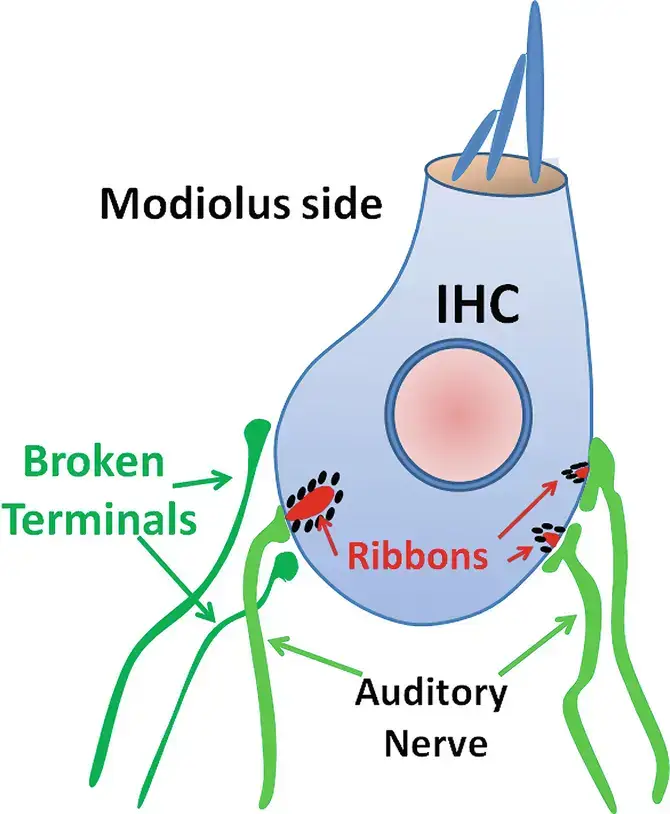
When we hear, movement in the cilia, the tiny hair cells in the inner ear, sends signals to the auditory nerve, also called the vestibulocochlear nerve or the 8th cranial nerve. Those signals cross synapses, the junctions between nerve cells, on their way to the brain. In ordinary hearing loss, the damage is to the cilia themselves or to the nerve. Hidden hearing loss often arises instead from a loss of synapses between nerve cells, so the signal arrives incomplete, missing the information the brain needs to fully interpret speech.
The exact cause isn’t fully understood yet. Animal studies have produced several working theories, and research is ongoing, but aging, long-term exposure to even low-level noise (though this specific link is genuinely debated among researchers), ototoxic medications, and demyelination have all been proposed as contributing factors.
Cochlear Synaptopathy: A Related but Distinct Term
If you search for hidden hearing loss, you’ll likely also come across the term cochlear synaptopathy. It’s one possible cause of hidden hearing loss, but not the only one. Neurons pass messages to each other across small gaps called synapses, using chemical neurotransmitters to make that jump. Synaptopathy refers to disease affecting those synapses specifically. Neurons also have a protective coating called myelin, which helps signals travel quickly and efficiently, and damage to that coating can slow or stop the signal outright.
In humans, cochlear synaptopathy currently can only be confirmed after death, using specific histological techniques to examine the cells under a microscope. That means a diagnosis in a living patient is essentially one of exclusion, ruling out other explanations rather than confirming this one directly.
How Is Hidden Hearing Loss Actually Tested For?
Since a standard audiogram can’t detect it, researchers are actively developing other approaches. Speech-in-noise or words-in-noise testing is one useful tool. Measuring the middle ear muscle reflex can capture how well the ear encodes subtle, rapid fluctuations in sound. One research approach even has participants wear special glasses that track pupil diameter while listening to speech in noise, on the theory that pupil size reflects how much mental effort it takes to understand speech under difficult conditions.
What Can Help Right Now
As the underlying causes become better understood, more targeted therapies are likely to follow. In the meantime, some medications show promise for helping regenerate synapses, and hearing aids with a dedicated speech-in-noise setting can genuinely help, using directional microphones to prioritize the sound in front of you and reduce background noise. Certain assistive listening devices, like a personal FM system, can help too.
If this sounds like your experience, don’t ignore it. Like most hearing-related issues, it tends not to improve on its own with time.
Could an OTC Hearing Aid Help?
Since hidden hearing loss passes a standard audiogram, many people assume hearing aids aren’t an option for them at all. That’s not necessarily true. The core problem in hidden hearing loss isn’t volume, it’s signal clarity in noise, and that’s exactly what a number of current OTC hearing aids are specifically designed to improve, even for someone whose hearing thresholds test as normal.
Many current OTC devices use directional microphones and AI-driven noise reduction to isolate speech from background noise and improve the effective signal-to-noise ratio reaching your ear, independent of overall amplification. Some models are built and independently tested specifically around speech-in-noise performance, scoring well above the category average on that measure in third-party lab testing. For someone with hidden hearing loss, that kind of targeted noise reduction can meaningfully help with exactly the symptom that’s hardest to live with: struggling to follow conversation in a noisy room, even though a hearing test says your hearing is fine.
That said, OTC hearing aids are regulated for perceived mild to moderate hearing loss, and hidden hearing loss doesn’t fit neatly into that framework since it isn’t captured by the audiogram at all. It’s worth a real conversation with an audiologist before you buy anything, to talk through whether an OTC device’s noise-reduction features are likely to help your specific symptoms, or whether a prescription device with more advanced speech-in-noise processing would serve you better. A trial period, with an OTC device’s return window of 45 days, is the most reliable way to find out. Contact us if you would like to learn more.
Browse OTC hearing aids built for speech in noise.
Learn about assistive listening devices that can help.
Not sure if it’s time for a hearing test? See the signs.



