When a hearing aid stops sounding right, the first question is always the same: is the problem the device, the programming, or my hearing? That question is harder to answer than it sounds, because hearing is subjective. What you hear through a hearing aid feels real to you, but it does not tell you objectively what the device is actually putting out.
Electroacoustic analysis answers that question with measurements. It is the objective test that tells you exactly what your hearing aid is doing, independently of how it sounds to you, independently of the software settings, independently of anything subjective. This post explains what the test measures, what psychoacoustics has to do with it, and when you should consider sending your hearing aids in for a professional check.
What Is Electroacoustic Analysis?
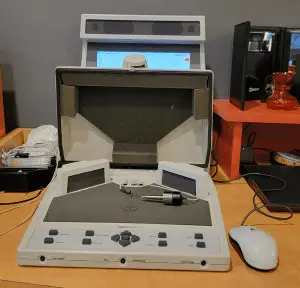
Electroacoustic analysis is a standardized method of measuring the physical performance of a hearing aid using a calibrated test chamber called a test box or hearing instrument analyzer. The hearing aid is placed in the box, a reference microphone measures the output, and a series of acoustic signals is introduced. The measurements produced are objective; the same device tested in the same conditions by any calibrated test system produces the same results.
The tests follow ANSI S3.22 standards, the American National Standards Institute specifications that manufacturers use to certify that hearing aids perform as labeled. When a manufacturer says a hearing aid produces a certain maximum output or follows a certain frequency response curve, those claims are verified through ANSI testing. The same measurements can be run on any hearing aid at any point in its life to compare current performance against the original specification.
What Electroacoustic Analysis Measures
Output Sound Pressure Level: OSPL90
The maximum output the hearing aid can produce before limiting, measured at 90 dB SPL input. This tells you how loud the device can get before it compresses or clips the signal. A device with a degraded receiver will show reduced OSPL90. For patients with significant hearing loss who need high output, this measurement directly predicts whether the device can meet their prescription needs.
Full-On Gain
The amount of amplification the hearing aid adds to an input signal at the maximum volume setting. Measured across frequencies. A device with a failing microphone will show reduced gain; it is not amplifying as much as it should because it is not capturing the input signal properly.
Frequency Response
The gain the hearing aid provides across the frequency range; typically 250 Hz to 8,000 Hz. This curve shows which frequencies are being amplified and by how much. A healthy hearing aid produces a smooth, predictable frequency response. Notches, dips, or peaks in an unexpected pattern indicate component problems, often the receiver, the microphone, or the wax guard obstructing the sound path.
Total Harmonic Distortion
The proportion of the output that consists of distortion rather than the intended signal. Low distortion means the hearing aid is reproducing the input signal cleanly. High distortion, particularly at low frequencies, can indicate receiver damage or battery problems. Distortion is often what patients describe as a scratchy, buzzy, or metallic quality that does not resolve with cleaning.
Battery Current Drain
How much current the hearing aid draws from the battery during operation. Abnormally high current drain can indicate internal component failure and explains why batteries are dying faster than expected. This is harder to measure now that we have rechargeable batteries that are not able to be tested in the box.
Attack and Release Times
How quickly the compression system responds to sudden loud sounds (attack) and how quickly it recovers to normal gain after the loud sound passes (release). Slow attack means the hearing aid lets loud sounds through too fully before compressing them, which some patients experience as a startling or uncomfortable sound quality.
Psychoacoustics: Why Objective Measurements and Subjective Experience Do Not Always Match
Psychoacoustics is the study of how the brain perceives and interprets sound, the relationship between physical acoustic measurements and subjective hearing experience. It is the bridge between what the electroacoustic test box measures and what the patient reports hearing.
Understanding this relationship explains several things that frustrate hearing aid users and sometimes even their audiologists:
Why a Technically Normal Hearing Aid Can Still Sound Wrong
A hearing aid can measure within ANSI specifications and still sound uncomfortable, unnatural, or fatiguing to the wearer. The reason is that ANSI specifications define a range of acceptable performance, not an ideal. A device performing at the edges of its specification range is technically passing while delivering suboptimal auditory experience. Psychoacoustic principles explain why:
- Spectral balance: the brain is exquisitely sensitive to the balance of frequencies in a signal. A hearing aid with even modest gain errors at specific frequencies can produce a perceptual quality, tinny, hollow, muffled, that is immediately noticeable even when the overall output is within specification.
- Temporal processing: the brain uses tiny timing cues in sound to locate sources, separate competing speakers, and understand speech. Hearing aids with slow attack or release times, or with processing artifacts in the temporal domain, disrupt these cues. The result is difficulty understanding speech in noise even when the device tests normally in quiet conditions. Temporal processing also changes as our brain ages and why some people will still have trouble with faster attack times.
- Distortion sensitivity: even low levels of harmonic distortion, well below what most specifications flag as a failure, can be audible and fatiguing to some listeners, particularly those with good cochlear fine structure remaining in certain frequency regions.
Why a Technically Degraded Hearing Aid Can Still Sound Acceptable
The brain is also remarkably good at adapting. A hearing aid with a gradually declining receiver produces progressively less output, but the wearer’s brain adapts to the change over weeks or months, recalibrating its perception of what sounds normal. The patient often does not notice the change until the device is compared against its original specification or against a functioning device. This is why electroacoustic testing catches degradation that patients miss subjectively.
The Loudness Perception Problem
Loudness does not scale linearly with sound pressure level, the relationship is logarithmic and further shaped by each individual’s cochlear function and hearing loss configuration. A patient with significant recruitment (abnormally rapid growth of loudness perception, common in sensorineural hearing loss) experiences the same output level as much louder than a patient without recruitment. Programming addresses this through compression, but the psychoacoustic reality is that two patients with the same audiogram can have very different comfortable loudness levels, and a device performing identically for both may sound too loud for one and too soft for the other.
When to Consider Electroacoustic Testing
Electroacoustic analysis is appropriate whenever subjective experience suggests the hearing aid may not be performing as expected:
- The hearing aid sounds different than it used to: especially if the change is gradual. Receiver degradation and microphone deterioration both produce progressive performance loss that is easy to miss subjectively.
- Batteries are dying faster than expected: abnormal current drain often indicates internal component failure before other symptoms appear. Again if you have rechargeable hearing aids, it may not be able to be tested.
- There is a new scratchy, buzzy, or distorted quality: distortion that does not resolve with cleaning and wax guard replacement suggests receiver or amplifier problems.
- The hearing aid is quieter than it used to be: reduced output can indicate receiver damage, wax obstruction deeper than surface cleaning reaches, or microphone deterioration.
- The device has been dropped or exposed to significant moisture: physical or moisture damage may not be immediately audible but can show in objective measurements.
- You purchased a consignment hearing aid and want to verify it: electroacoustic testing is the professional standard for confirming used hearing aid performance before purchase or programming. Of course, we test all our consignment hearing aids in the test box before listing them in our store.
- Programming adjustments are not resolving a persistent complaint: when software-side changes do not fix an auditory complaint, hardware-side testing determines whether the problem is in the programming or the device itself.
Where Electroacoustic Analysis Fits in the Complete Fitting Picture
Electroacoustic analysis is one part of the professional verification process for hearing aids. The complete picture involves three connected steps. Fitting standards define the clinical protocol, bilateral fitting, real ear verification, appropriate coupling, and style for the degree of loss. Real ear measurement confirms that the programming is delivering the prescribed amplification targets to the wearer’s eardrum. Electroacoustic analysis confirms that the hardware is physically capable of producing what the programming asks of it.
The three are complementary rather than overlapping. A hearing aid can pass electroacoustic testing while being programmed incorrectly for the wearer’s loss. A hearing aid can have accurate real ear measurements while having a failing receiver that will degrade further over time. And a fitting that skips real ear measurement may technically meet the programming targets in software without confirming what actually arrives at the eardrum. Together, the three create a complete verification chain from protocol to programming to hardware.
Our Electroacoustic Analysis Service
Hears Hearing & Hearables offers professional electroacoustic analysis for hearing aids sent in by mail. Every consignment hearing aid we list has been through this process. We also offer the service for patients who want an independent, objective check of hearing aids they already own, whether purchased elsewhere, received as a gift, or simply aging and suspected of declining performance.
- What you do: purchase the diagnostic service and mail your hearing aids to us using a trackable shipping method.
- What we do: test your hearing aids in our ANSI-certified hearing instrument analyzer, measuring output, gain, frequency response, distortion, and battery current drain across the device’s operating conditions.
- What you receive: a professional report of the measurements and what they indicate about the device’s current performance relative to its original specification.
- If we cannot complete the analysis: if a device arrives in a condition that prevents testing, severe physical damage, missing components, or incompatible format, we return the hearing aids and refund the service cost minus shipping and processing fees.
Electroacoustic analysis tells you what your hearing aid is actually delivering, not what it feels like it is delivering. For patients troubleshooting persistent performance complaints, considering a consignment purchase, or simply wanting an objective baseline on aging devices, this is the professional standard for answering the question definitively.
Purchase electroacoustic analysis service | Contact us with questions
Not sure whether your hearing aid needs professional analysis or just a cleaning? Start with our troubleshooting guide to rule out common simple causes, wax guard replacement, cleaning, and battery check resolve the majority of sudden performance changes. If the problem persists after those steps, electroacoustic testing is the right next move.
Frequently Asked Questions: Electroacoustic Analysis
What is electroacoustic analysis and why does it matter?
Electroacoustic analysis is standardized objective testing of a hearing aid’s physical performance using a calibrated test chamber. It measures output levels, gain across frequencies, distortion, and battery drain, producing results that are independent of how the device sounds subjectively to the wearer. It matters because subjective hearing experience can be misleading: a device can sound normal while performing below specification, or sound wrong while testing normally. Objective measurement answers questions that subjective impression cannot.
How is this different from my audiologist adjusting my hearing aids?
Programming adjustments change the software settings inside the hearing aid, amplification targets, compression ratios, noise management behavior. Electroacoustic analysis measures the hardware performance of the device itself, whether the physical components are functioning as designed. A hearing aid with a failing receiver will not respond normally to programming adjustments. Electroacoustic testing identifies hardware problems that software changes cannot fix.
What is psychoacoustics and why does it matter for hearing aids?
Psychoacoustics is the study of how the brain perceives and interprets sound, the relationship between physical measurements and subjective hearing experience. It explains why two people with the same audiogram can have different comfortable loudness levels, why a technically normal hearing aid can still sound wrong to a specific wearer, and why the brain adapts to gradually declining hearing aid performance without consciously noticing the change. Understanding psychoacoustics helps explain the gap between what objective testing measures and what the patient reports experiencing.
My hearing aid sounds fine. Should I still get it tested?
Electroacoustic testing is most valuable when something sounds wrong, distortion, reduced volume, changed sound quality. However, there are situations where testing a device that sounds acceptable makes sense: before purchasing a consignment hearing aid to verify performance, after a device has been dropped or exposed to moisture, or for older devices as a baseline before problems appear. The brain adapts to gradual performance decline, meaning a device can be performing significantly below specification while still sounding ‘normal’ to the adapted wearer.
How do I send my hearing aids in for testing?
Purchase the electroacoustic analysis service from our product page, then mail your hearing aids to us using a trackable shipping method. We recommend a padded envelope or small box with adequate protection. Include your contact information and any notes about the symptoms or concerns you want addressed. We will test the devices and return them with a report of the measurements.
What happens if my hearing aid fails the electroacoustic test?
If testing reveals performance outside acceptable parameters, the report will specify which measurements are out of range and what they suggest about the likely cause. Common findings include receiver degradation, microphone deterioration, or distortion indicating amplifier issues. Depending on the age and model of the device, repair, receiver replacement, or manufacturer service may be appropriate next steps. Our mail-in repair service can address many common hardware failures.