When Apple announced that AirPods Pro 2 would function as FDA-cleared over-the-counter hearing aids, I had two reactions. The first was genuine excitement. Apple did something decades of public health campaigns couldn’t: it made ordinary people curious about their hearing. The second was measured skepticism. Hype and performance are different things, and I worried people with actual hearing loss were about to make purchasing decisions based on marketing rather than clinical reality.
Now that the feature has launched, independent lab testing has been done, and audiologists across the country have evaluated it in clinical settings. Therefore we now have real data to analyze. This post covers what Apple’s hearing aid feature actually does, what the numbers say, where it falls short, and, most importantly, who it’s might be right for and who would be better served by something else.
This isn’t a teardown of Apple. It’s a professional assessment from someone who has spent a career helping people hear better. And the honest conclusion is more nuanced than either the glowing tech reviews or the dismissive audiologist critiques.
What Actually Happened: Apple’s FDA Clearance, Explained
In September 2024, the FDA authorized Apple’s Hearing Aid Feature (HAF) software, making it the first over-the-counter hearing aid software device ever cleared by the agency. This is distinct from a hardware clearance. The AirPods Pro 2 earbuds themselves were already an existing consumer product. What the FDA cleared was the software that transforms them into a regulated hearing aid.
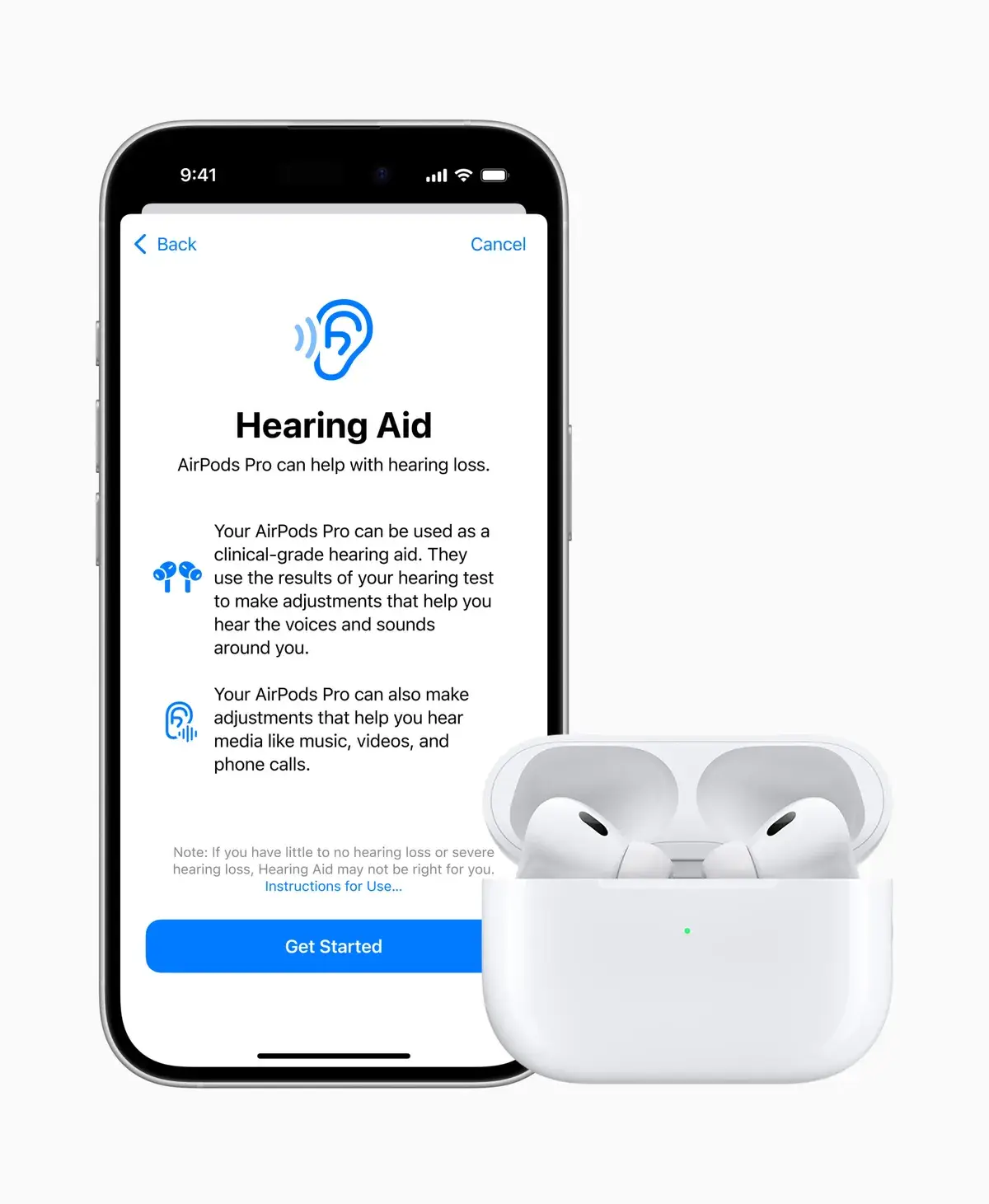
The feature became available in October 2024 via iOS 18.1 for AirPods Pro 2 paired with a compatible iPhone or iPad. AirPods Pro 3, released later, also supports the feature. Here’s how it works:
- A built-in 5-minute Hearing Test uses the AirPods’ microphones and your iPhone to assess your hearing across frequencies, and no audiologist visit is required
- If mild to moderate hearing loss is detected, you’re prompted to set up the Hearing Aid feature using your personalized hearing profile
- Alternatively, you can upload an audiogram from a hearing professional directly into Apple’s Health app
- The feature then applies real-time amplification tuned to your hearing profile, with adjustable volume, tone, and balance controls
- Conversation Boost uses beamforming to focus on voices directly in front of you in noisy environments
- Hearing Protection monitors environmental noise levels and reduces exposure to sounds that could damage hearing
The Hearing Aid feature requires iOS 18.1 or later and is intended for adults 18 and older with perceived mild to moderate hearing loss. It is not available for Android users, obviously, iPhone is required.
What Independent Testing Actually Found — The Unvarnished Numbers
Multiple independent labs have now evaluated the AirPods Pro 2 as hearing aids. The results tell a consistent story. Capable but limited, with performance that varies significantly based on how well you set them up.
HearAdvisor Lab Testing
HearAdvisor (the most credible standardized OTC hearing aid testing source), gave the AirPods Pro 2 a “B” SoundGrade. In context:
- Music streaming quality: 4.40/5- well above category average. This is genuinely excellent.
- Feedback handling: 5.00/5 – perfect score. No whistling issues in testing.
- Speech in quiet (initial fit, out of box): 1.80/5 – below category average
- Speech in noise (initial fit): 0.80/5 – poor. This is the most important metric for real-world hearing aid use, and out-of-box performance is weak.
- Own-voice comfort: 1.90/5 – below average, due to occlusion from the closed coupling
- Overall initial fit score: 2.17/5
The critical finding: performance improved substantially with proper tuning and setup. This means the AirPods Pro 2 can perform better than its out-of-box numbers suggest, but only if the user takes time to optimize settings. Ideally with professional guidance. Users who put them in and expect them to work immediately will likely be disappointed.
National Acoustic Laboratories Research (Published April 2025, The Hearing Review)
Researchers from National Acoustic Laboratories in Sydney conducted controlled laboratory measurements published in The Hearing Review. Key findings:
- The Hearing Aid Mode provided meaningful amplification gains for mild to moderate hearing loss profiles
- Beamforming and signal-to-noise ratio improvements were measurable but limited compared to purpose-built hearing aids
- The Media Assist and Conversation Boost modes showed real-world utility for specific listening situations
- Performance in challenging acoustic environments remained a limiting factor compared to dedicated hearing aid devices
The researchers concluded that the AirPods Pro 2 represents a meaningful step in integrating consumer technology into hearing care. However, noting key considerations for users include battery life, severity of hearing difficulty, and willingness to wear earbuds for regular hearing support.
The Honest Limitations; What the Marketing Doesn’t Emphasize
Battery Life Is the Single Biggest Practical Problem
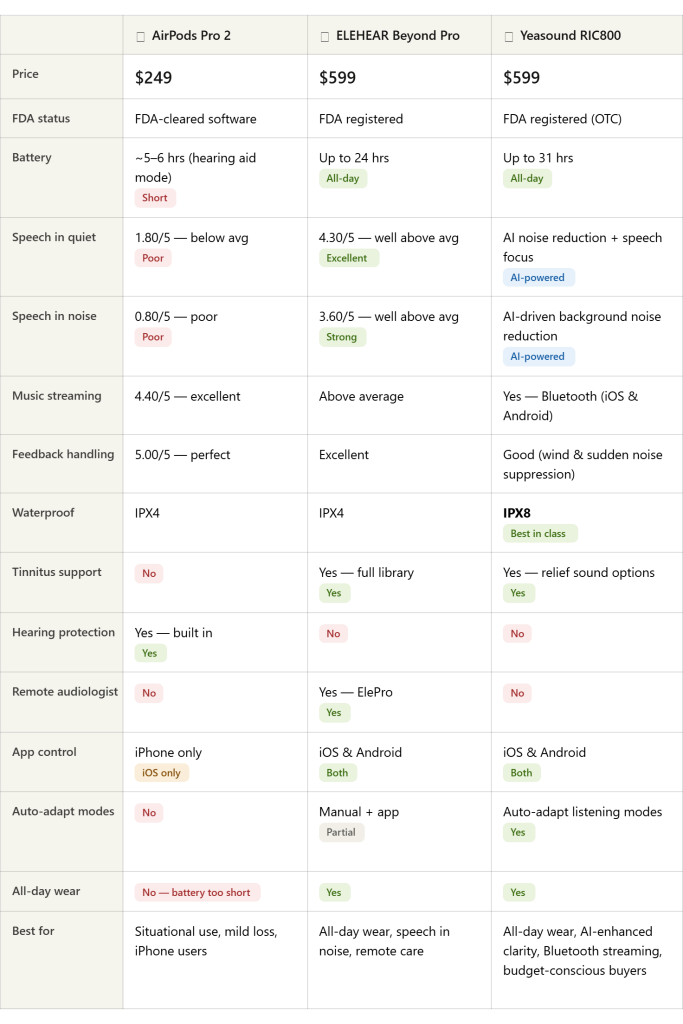
This is the limitation that matters most for everyday use. The AirPods Pro 2 provide approximately 5 to 6 hours of battery life in hearing aid mode. However, some audiologists report even less in real-world conditions. Most hearing aid users need 12 to 16 hours of reliable performance to get through a full day. That gap is significant.
Practically, this means AirPods Pro 2 work well as a situational hearing aid such as going out to dinner, a meeting, an event, but not as an all-day solution. You would need to recharge during the day, which most people find impractical. If all-day hearing support is what you need, this is a genuine dealbreaker.
Speech in Noise Performance Is Below Dedicated OTC Devices
Noisy environments, restaurants, social gatherings, busy streets are precisely where people with hearing loss struggle most. This is also where the AirPods Pro 2’s speech-in-noise score of 0.80/5 out of the box is most concerning. Even with tuning (2.60/5), it remains below the category average for purpose-built OTC hearing aids. Other devices, like the ELEHEAR Beyond Pro, scored 3.60/5 for speech in noise, a meaningful real-world difference.
Limited Adjustability Compared to Dedicated Hearing Aids
Audiologist-measured data shows the AirPods’ volume range spans roughly 10 dB which is about half what conventional hearing aids offer. Tone adjustments are limited to 3–4 dB in either direction. For users with classic high-frequency hearing loss (the most common pattern, where high-pitched sounds are harder to hear than low ones), this limited range may not provide adequate amplification at the frequencies where they need it most.
In-App Hearing Test Accuracy Depends on Environment
The self-administered hearing test can be a useful starting point, but its accuracy depends heavily on the listening environment during testing. Multiple reviewers found that background noise caused the test to return ‘Unable to Classify’ results. The test performs best in a very quiet room, a condition not everyone can reliably create at home. If you have an audiogram from a hearing professional, uploading it directly to the Health app produces more reliable results than the self-test.
iPhone Required; Android Users Are Excluded
The Hearing Aid feature works only with iPhone or iPad running iOS 18.1 or later. Android users cannot access the hearing aid functionality at all. This is a significant limitation that most reviews mention briefly but deserves direct emphasis: if you don’t use an iPhone, AirPods Pro 2 are not a viable OTC hearing aid option for you.
Social Perception
AirPods are widely worn for music and calls, which normalizes their appearance, but it can also create the impression that you’re listening to something rather than listening to the people around you. Some users and clinicians have noted that the social signal of wearing AirPods may actually create more communication barriers than a less conspicuous hearing aid. Worth considering if you’re in professional environments where appearing fully present matters.
What Apple Actually Got Right
A balanced assessment requires acknowledging where Apple has genuinely moved the needle, because they have.
- Awareness: Apple did something no OTC hearing aid brand has managed. It put hearing loss in front of people who had never thought about it. The built-in Hearing Test feature is surfaced to all AirPods Pro users, not just those already seeking help. That exposure has real public health value.
- Price point: At $249, AirPods Pro 2 are one of the most affordable FDA-cleared OTC hearing aids on the market. For someone with very mild hearing loss who already uses AirPods for other purposes, the hearing aid feature is essentially free.
- Integration: For existing iPhone users, the integration with the Health app, audiogram storage, and Apple ecosystem is genuinely seamless. Setup is faster and more intuitive than most OTC hearing aids.
- Feedback handling: The perfect 5.00/5 feedback score means no whistling, a common frustration with in-ear hearing devices that Apple has managed well.
- Music streaming: The 4.40/5 music streaming score is outstanding. If audio quality for media matters to you alongside hearing support, AirPods Pro 2 outperform most dedicated hearing aids in this dimension.
- Hearing Protection: The active noise monitoring and protection feature, which alerts you to loud environments and helps prevent further hearing damage which is genuinely novel and valuable. No other OTC hearing aid includes this.
What Apple’s Entry Means for the OTC Market: A Professional Perspective
The original concern among smaller hearing aid companies and independent audiology practices was that Apple would simply overwhelm the market with brand power. That concern was legitimate. Apple does have near-unmatched reach and marketing muscle.
But the performance data has done something interesting: it’s demonstrated that Apple’s entry doesn’t replace the OTC market. Rather, it redefines what the entry point looks like. AirPods Pro 2 work best as a gateway for people who’ve never addressed hearing loss, or as a situational aid for someone with very mild loss in specific environments.
What they don’t do is threaten the market position of purpose-built OTC hearing aids designed for all-day wear, speech clarity in noise, or more significant hearing loss.
What Apple has succeeded in doing is something the entire industry has struggled with for years. Reducing the stigma around hearing loss by making hearing aids feel like consumer technology rather than medical devices. That rising tide has the potential to lift the whole category, including the independent providers and smaller brands that have built genuinely excellent products with less marketing budget than Apple spends in an afternoon.
At Hears Hearing & Hearables, we’re watching this space carefully. We believe there is room for Apple AND for the innovative companies that have been building specialized hearing solutions for years. Hearing care is not a winner-take-all market, because no single product fits every ear or every life.
So, Should You Use AirPods Pro 2 as a Hearing Aid?
Here’s the professional assessment, as plainly as I can give it:
AirPods Pro 2 as OTC hearing aids: a genuine option for the right person yet a poor fit for most people with significant hearing needs.
- Good fit if: you’re an iPhone user with very mild hearing loss, you already own AirPods Pro 2 or plan to buy them anyway. You need situational rather than all-day hearing support, and you primarily struggle in quiet one-on-one or small group settings rather than noisy environments.
- Poor fit if: you need all-day hearing support (battery life is insufficient), your biggest challenge is hearing in noisy environments (speech-in-noise performance is below average), you use Android, or your hearing loss is moderate-to-significant.
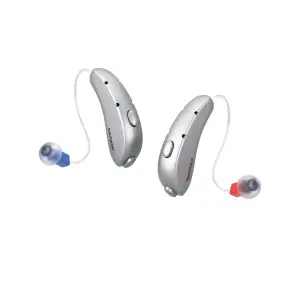
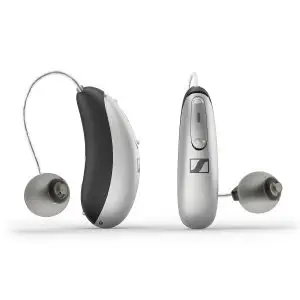
- Consider a dedicated OTC hearing aid instead if: you want all-day wearability, stronger speech-in-noise performance, or more precise adjustability. Devices like the ELEHEAR Beyond or Beyond Pro consistently outperform AirPods Pro 2 on the metrics that matter most for real-world hearing support.
- Consider a professionally fit hearing aid if: your hearing loss is more than mild, you’ve tried OTC options without adequate results, or you want programming precision that self-fitting simply cannot replicate. A single hearing evaluation can tell you which tier is appropriate for your needs.
And if you already own AirPods Pro 2 and haven’t tried the hearing aid feature, try it. At zero additional cost, it’s worth knowing how it performs for your specific hearing situation. Just don’t buy AirPods Pro 2 specifically as a hearing aid without understanding the limitations first.
Not Sure What’s Right for You? We Can Help.
At Hears Hearing & Hearables, we can help you figure out whether AirPods Pro 2, a dedicated OTC device, or a professionally fit hearing aid is the right starting point for your hearing needs.
Take our free Hearing Handicap Screening Test as a first step, or reach out directly for a personalized recommendation.
Browse our OTC hearing aid selection or contact our team.
AirPods Pro 2 vs. Dedicated OTC Hearing Aids: Quick Comparison
Frequently Asked Questions: AirPods Pro 2 as Hearing Aids
Are AirPods Pro 2 FDA approved as hearing aids?
Yes. In September 2024, the FDA authorized Apple’s Hearing Aid Feature (HAF) software, making it the first over-the-counter hearing aid software device cleared by the FDA. The feature became available in October 2024 via iOS 18.1 for AirPods Pro 2 paired with a compatible iPhone.
How long does the AirPods Pro 2 hearing aid battery last?
Approximately 5 to 6 hours in hearing aid mode, significantly less than the 12 to 16 hours most people need for all-day hearing support. This is the most significant practical limitation of using AirPods Pro 2 as hearing aids. They are better suited for situational use than continuous daily wear.
Do AirPods Pro 2 work as hearing aids for Android users?
No. The Hearing Aid feature requires an iPhone or iPad running iOS 18.1 or later. Android users cannot access this functionality.
How do AirPods Pro 2 compare to dedicated OTC hearing aids?
AirPods Pro 2 have excellent music streaming and feedback handling, but score below the OTC category average for speech in quiet and poorly for speech in noise in initial testing. Dedicated OTC hearing aids like the ELEHEAR Beyond Pro significantly outperform AirPods Pro 2 on speech clarity metrics, particularly in noisy environments, and provide far longer battery life for all-day use. AirPods Pro 2 are better suited as a low-cost entry point for mild hearing loss than as a replacement for purpose-built hearing aids.
Can I use my audiologist’s hearing test results with AirPods Pro 2?
Yes. If you have an audiogram from a hearing professional, you can upload it directly into Apple’s Health app rather than using the built-in self-test. This approach is more reliable than the self-administered test and tends to produce better results.